Sunday, 4 August 2013

Smallcaps forge ahead

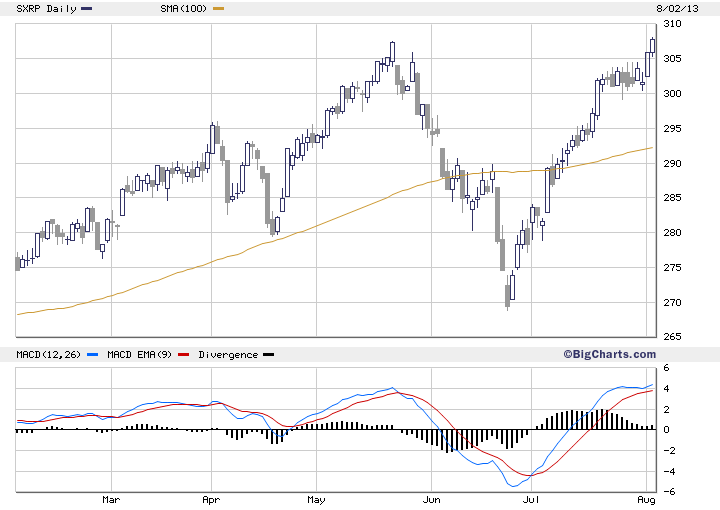
Yet again, I am pleased to report that stock markets have made further progress through the month of July, led by smallcaps yet again. 

UK Smallcaps breaking new highs

Japanese stocks have also recovered to a surprising extent, with a promising uptrend looking to be re-established once again.

Nikkei index rebounds off the 100-day moving average

On the sector front, the Insurance and Retail sectors have shown the most resilience in recent weeks, surging to new 52-week highs and leading the way within European stock markets. This to some extent reflects the improving economic fundamentals in Europe, reflected in the surprising recent fall in the European unemployment rate and corporate reports of better European business activity.

European manufacturing activity is picking up


European Insurance sector maintains a strong uptrend

And Retail stocks are also threatening to set new highs too

Current Insurance stock favourites which offer a tempting combination of value (e.g. high dividend yield, low price/book value) include Delta Lloyd (DL), Aviva (AV) and AXA (CS). In Retail, I continue to favour UK mid- and small-caps such as Sports Direct (SPD), Darty (DRTY) and Inchcape (INCH).

Overall, while I remain cautious given the strong stock market advance since November of last year, there are several pockets of positive momentum that can still be exploited, in particular in the mid- and small-cap space. 

Best of luck, 
Edmund


Tuesday, 9 July 2013

Greenback and Loonie winning the forex race, but will the Yen or Aussie get the wooden spoon?

Long-term FX winners and losers

While I love looking at stocks and shares, particularly since November of last year which has been kind to the equity investor, I have also been tracking a combination of different macro trends have thrown up a number of clear, long-term trends in FX. 

The Greenback: Setting off on a bull run!

A backdrop of improving macroeconomic trends (unemployment, housing, retail sales) combined with the belief that the Fed will finally start to put a very gentle brake on their rash of bond buying, is the backdrop for a strengthening US dollar. The US dollar index (chart below) has responded to these trends by rocketing up the currency charts over the last few weeks, adding 5% in this very short time window.

US Dollar Index Hits a 12-Month High!
While you may start to worry about potentially buying the US dollar at the top, note that there is still a fair way to go before the US dollar index reaches multi-year highs...

5-Year Peak For USD Was Around 89, vs. 84.6 now

The Loonie is also worth watching...

Now while the Canadian dollar has been a strong currency for quite a while now, note that the recent trend for the Loonie has been a weakening rather than strengthening, at least against its Southern neighbour:

US Dollar Has Strengthened Against CAD Since Sept. 2012
But that being said, the Loonie should be aided by stronger Canadian export performance (thanks to current FX weakness) and of course the follow-through from a stronger US economy (the Canuck's biggest trading partner by far) and higher oil prices (they are a big oil producer thanks to oil sands). 

Note that the Canadian bank CIBC is predicting that the Loonie could return to parity against the Greenback by the end of 2014 (CIBC's Monthly FX Outlook - June 2013), suggesting that it should remain a stronger currency within the G10 currencies (the 10 most heavily-traded currencies). 

Can the Aussie Dollar Slide Even Further? Could be...

The two key drivers for a weaker Australian dollar have been: 

(a) a clear slowing in the Chinese economy growth rate, impacting demand for Australian-sourced commodities like iron ore, coking coal and copper, and 

(b) The Reserve Bank of Australia cutting interest rates, now down to 2.75%:

Australian interest rates have been cut several times recently
Now hardly surprisingly, given the worries over the Chinese slowdown impacting Australian commodity exports and lower interest rates also making the Aussie dollar less attractive, the AUD has slid quite dramatically against most currencies since the beginning of April this year. 

However, looking at a 5-year chart, it would seem evident that the AUD could yet weaken quite a bit further, since the 5-year low for AUD/USD was 0.62 versus 0.92 now. 

A very long way for the Aussie dollar to go to plumb 5-year lows
I think that the major risk for the Australian economy (and by extension its currency) remains that of a greater-than-anticipated slowdown in Chinese economic growth. For now, financial markets seem to be happy with the idea that the Chinese government will slow the economy just enough to curb inflation and manage the transition from an investment-led to consumer-led economy. I would suggest that this perception could change quite quickly, and potentially lead to the AUD weakening further from here. 

Abenomics continues to weigh on the Yen

A key plank of the Japanese government's reflation effort for their economy rests on weakening the Yen sufficiently to stimulate the country's car, industrial and technology exporters to drive growth. The Bank of Japan seems similarly determined to continue to add monetary stimulus in the form of buying financial assets (not just bonds, but potentially also stocks), all of which argues for a yet weaker Yen. 

After a short period when the Yen reversed its weakening trend against all other G10 currencies, we are now back to a steadily weaker Yen once again as the BoJ are expected to expand their Quantitative Easing program, just as the US Fed are supposedly going to start pulling back gently on theirs. 

Yen has resumed its weakening trend against the US dollar

Conclusion: USD and CAD set to gain ground, weaker AUD and JPY in prospect

I think there will be a number of opportunities in the months ahead to go long both the USD and CAD against the AUD and JPY, extending the trends that have already been in place for some time now. Never underestimate the ability of a financial market trend to persist for longer than you can possibly imagine...

Edmund


Saturday, 6 July 2013

Post BoE/ECB Markets Landscape: Small-caps, US Dollar show relative strength, Commodities still laggards

BoE, ECB lower for longer?

Following the forward guidance given both by the new Bank of England Governor Mark Carney, and President Draghi of the European Central Bank at their respective central bank rate-setting meetings, what can we divine from the reaction of various financial markets?

First off, no bones about it - both the Bank of England and the ECB remain fully engaged in supporting the fragile economic growth rates seen in Europe (Bloomberg - ECB signals prolonged low rates). We have been recently reminded of how fragile any economic stability is across the Continent by the volatile reactions to the resignations of 2 ministers in the Portuguese government, plus the emergence of cracks in support for the incumbent Italian government. Notice how the Portuguese bond yield surged beyond 7% in short order in response to this renewed political volatility, triggering reactions across the whole of Europe. 


Portuguese 10-year bond yield spikes up to 7+%
Let's have a quick tour of the various financial markets, to see where there are enduring trends to be identified. 

FX: US Dollar rules

As far as currencies go, the strength of the US employment data on Friday with 195,000 new jobs created in the month of June, plus upwards revisions to the jobs data for both April and May (BLS - US employment situation, June 2013), supported the US dollar, with the US dollar index (DXY) responding by making a new 1-year high.


US Dollar index breaks a new 12-month high


Sterling has been a major loser in contrast, with GBP/USD dipping below $1.50 following the Bank of England statement. 

Bonds: Still making new lows

The bond markets have not managed to reverse their bearish trend, with bond indices still sliding lower following the various central bank statements and the US economic data releases on Friday. Not yet time to dip back into buying government bonds, just yet then. 

US Treasury bond ETFs hit a new 12-month low on Friday

Commodities: Industrial metals, foodstuffs still weak as well

Another area not yet ready for buying is the commodities space: despite sizeable slumps in industrial metals, precious metals, and foodstuffs over the last 12 months, there has not yet been any discernable change in underlying trend... The mining sector continues to mirror this commodities malaise, still the worst-performing sector in the European stock market in the year to date.

Sugar dives ever lower

Don't try to catch this European Mining falling knife

Stock Markets: Small-caps holding up best,
No reason to return to Emerging markets yet

Looking at the UK and US stock markets, the outperformance of small-cap stocks continues to surprise me. However, they remain of course a good play on improving economic momentum in both countries, particularly relative to other areas such as Banks (which tend to be large-caps) or even Emerging Markets. Within Asian equities, Japan clearly remains the place to be, with the Baillie Gifford Japan investment trust (BGFD) returning to within a whisker of its 2013 peak on Friday.

US S&P Smallcap 600 Index Breaks New Highs

While UK Small-caps also look ready to return to recent highs

However, within European large-caps I would be wary of the Banks sector which has broken its 200-day moving average, while Emerging Market equities remain firmly out of favour. 

No inflection point yet for Emerging Market equities

And European Banks also look vulnerable

Conclusion: Small-Cap stocks look good, but beware Banks, Commodities

Stay long UK, US small-caps, and housing-related areas including Lumber (but not US homebuilders, which have already benefited from enormous revaluation). Stay long Japanese shares too, although the Yen will likely weaken further against the US dollar.

In contrast, there is a long list of financial assets to avoid or even short outright potentially: Emerging Market equities, European banks, industrial metals like copper and the related Mining stocks, and European Oil & Gas stocks. This is not to mention most commodity foodstuffs like sugar and coffee, which continue to touch new 12-month lows. 

Good luck for Monday and hope you are profiting from the belated arrival of Summer in the UK and France,

Edmund


Tuesday, 2 July 2013

Oz no longer great nor powerful

Sell the Australian dollar, Australian stock market?

Chart 1 below clearly the break in the 2-year uptrend in the Australian stock market since mid-May of this year. A simple reading of this chart would suggest that the former support level around 4,900, now decisively broken, becomes resistance for any rally to the upside. With the ASX/200 index currently trading at 4,834, this would suggest that there is certainly a lot of risk in holding Australian currency or shares right now.


Chart 1: Australian ASX/200 uptrend decisively broken
Source: Bigcharts.com

Chart 2: Australian dollar in downtrend against USD

Equally well, the strengthening trend of the Aussie dollar agains tthe US dollar has also reversed, with the Aussie dollar close to a 12-month low (Chart 2).

What fundamental reasons can we put this change of trend down to?

1. China - a slowing rate of growth points to slower growth in commodities demand from Australia, in both industrial metals and coal. 

It is hardly surprising to see that the European Basic Resources sector (miners with Australian assets such as BHP Billiton and Rio Tinto) has been the worst-performing sector in the year to date. Note that the lastest HSBC manufacturing Purchasing Managers Index was again below 50, indicating contraction rather than expansion in the Chinese manufacturing sector as of June. 

2. The Royal Bank of Australia is expected to cut interest rates in the near future to support the Australian economy; this however should lead to a weakening currency, other things being equal. 

3. Political landscape shifting, with Julia Gillard ousted as Prime Minister by Kevin Rudd, introducing an additional element of uncertainty and thus volatility. 

The noted macroeconomic strategy service The Bank Credit Analyst have come to a similar conclusion, given the increasing reliance of the Australian economy on mining exports (72% of total exports as of 2011/12). Australia-a-fading-star

Conclusion: In currency, prefer the USD, Euro or GBP to Australian dollar, at least until the Royal Bank of Australia cuts interest rates aggressively. In equities, the ASX/200 looks more likely to fall than rise from current levels, and looks set to continue to under-perform other developed stock markets. I continue to prefer the Japanese stock market given the growing evidence that Abenomics is having a positive effect finally on the Japanese economy. 


Friday, 28 June 2013

Could we finally see the beginning of the so-called "Great Rotation"?

Up to now, there has been little real sign of the much-vaunted Great Rotation this year, supposedly out of bonds and into stocks & shares. It simply has not happened: judging by data on fund flows in the US and UK for this year, we have seen investors putting new money into BOTH stock and bond funds over the months up to April. 

So no sign thus far of any flight from bonds and into stocks, then. However, today I stumbled across this headline in the Financial Times:


With government bond yields rising sharply given the fears over central bank withdrawal of monetary stimulus, it is true that bond investors have had a rough time since early April, as can be seen from the chart of the UK gilt ETF below, whose price dropped from a peak of 1212p to just 1136p now, losing investors over 6% in the process. Given that UK 10-year government bonds yield 2.4% currently, that is a lot of money to lose in less than three months...

UK Gilt ETF Drops Sharply
Source: Bigcharts.com
Interestingly, a relatively defensive sector like Healthcare is roughly flat over the same period, not only offers a 4%+ dividend yield but also offers the prospect of dividend growth to boot, something that bonds can never offer. 

Which sectors can benefit from rising bond yields?

Historically speaking, when long-term bond yields have risen faster than short-term interest rates (in technical speak, a "steepening of the yield curve") as is happening now, the sectors that have outperformed have been:

1. Media
2. Autos
2. Mining

Well, clearly Mining is not working, as it is the worst-performing sector so far this year. However, Media is outperforming nicely, led up by TV, advertising and newspaper stocks (ProSieben Sat1, ITV, Daily Mail, WPP). 

Who gets hurt by rising bond yields?

Rising bond yields could spell trouble ahead for bond-sensitive sectors such as Utilities, Infrastructure stocks and Telecoms. 

A nice mixture of dividend yield (income) and dividend growth: Dividend Aristocrats

If you are a bond investor looking to rotate out of government or corporate bonds and want some easy stock income growth funds to buy instead, I would suggest that you have a look at the following two Dividend Aristocrat ETFs from State Street, based on S&P Dow Jones Indices:

1. SPDR Euro Dividend Aristocrats (EUDV)
2. SPDR UK Dividend Aristocrats (UKDV)

Both contain an interesting blend of dividend yield plus potential dividend growth, and tend to hold a lot of low volatility stocks, so should benefit over time from the better risk-adjusted performance of low volatility stocks versus the overall stock market. 

Interestingly, both have held up very well during the recent market volatility, and look ready to move higher once again:

UK Dividend Aristocrats regaining ground

Good luck and bon weekend!
Edmund