Showing posts with label Retail. Show all posts

Tuesday, 16 June 2015

UK goes mad over online shopping - BooHoo and Sports Direct worth an investment look

I admit it – I just love buying stuff on Amazon. I love the simplicity, the speed, the ease; such a contrast to actually having to go out and find a shop on the high street that actually stocks what I want, and at a price I am prepared to pay!

Clearly, I am not alone.

The UK is gripped by online shopping fever

Today, almost £1 in every £8 is now spent online in the UK (Figure 1), by over 42 million digital shoppers. Now that is quite a feat, particularly when you realise that only 4% of all food sales are done online.

Online now represents more than £1 in every £6 spent on non-food sales, according to the British Retail Consortium.

1: Over 12% of total retail sales are done online

Source: ONS

As you might expect, online sales are growing faster than retail sales in "bricks and mortar" shops.

Online shopping grew 13% over the last year (to April 2015; Figure 2), compared with overall retail sales growth of under 5% since April 2014.

2: Online retail sales up 13% in a year

Source: ONS

UK is the European leader of internet shopping

Did you know that we in the UK are in fact the world leaders in internet shopping?

This year, we are predicted to spend nearly £1,200 shopping online, even more than the average American online shopper and around 10% more than in 2014 (Figure 3).

3: UK shoppers spend an average of £1,174 online
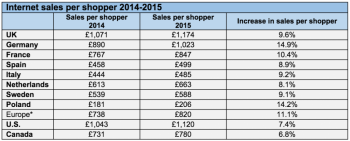
Source: econsultancy.com

Delving into the top 50 ecommerce retailers in the UK, 30 of them are from the retail sector, while another 12 are in travel, transportation and leisure.

Some of the top e-tailers are immediately obvious to anyone who has not been living in a proverbial cave: Amazon, Apple iTunes, and eBay.

Online shopping via mobile phones and tablets is now the fastest-growing area of ecommerce. And the top UK mobile retail category for searches is fashion, in the form of clothing, apparel and accessories. 65% of smartphone users search for fashion items using their device, according to Econsultancy (Figure 4).

4: Fashion is the most popular mobile retail search

Source: econsultancy.com

Investing in UK online retail

In the UK, BooHoo (code BOO), Asos (ASC) and Sports Direct (SPD) are all direct beneficiaries of this move to buying sports and fashion clothing online, at the cost of more traditional high street clothing chains such as BHS and TopShop.

Out of BooHoo, Asos and Sports Direct, I am particularly keen on BooHoo and Sports Direct as good long-term online retail plays.

A quick check on the Alexa web ranking website gives a very positive first impression (Figure 5). BooHoo.com is certainly getting more popular relative to other online retailers.

5. BooHoo.com is becoming more popular, relative to other similar websites

Source: Alexa.com

What is more, BooHoo's 10 June trading update highlighted a 35% increase in sales for the 3 months to 31 May, with 3.3 million active customers worldwide (32% more than a year ago).

Very strong growth, backed by lots of cash which can be used to make further investments for future growth too.

All in all, this looks a rather attractive proposition to me at BooHoo's current 28p share price.

Sports Direct harness Click and Collect

Sports Direct's website makes great use of their brick-and-mortar chain of stores to offer a "click and collect" service. With Click and Collect, you first order your sports goods on their website, and then collect the parcel from your chosen local Sports Direct store once it has arrived.

Online sales are now over 14% of Sport Direct's total sales, but are growing at an 11% annual clip and are also helping to improve the company's profitability.

While you pay £4.99 for this delivery option with Sports Direct, you get a £5 voucher back to spend in store when you collect your order. So while in principle you pay nothing for delivery, it cleverly entices you to make another purchase from either the store or the website.

Conclusion: BooHoo and Sports Direct are two great ways to invest in the UK online shopping boom.

Thursday, 28 May 2015

Make money from a strong pound at Marks and Spencer and Majestic Wines

IBTimes Video Link (click below):


This week, pound sterling hit its highest level against other major world currencies for over seven years (figure 1), judging by the Bank of England's Pound sterling index.

Figure 1: Trade-weighted pound back at highest since mid-2008

Source: Bank of England

This latest surge has been driven by the political certainty given by a Conservative general election victory, plus a following wind for the UK economy as:
  • Unemployment continues to fall
  • Retail sales surge higher (+4.7% year-on-year in April 2014)
  • The domestic property market resumes its upwards march.
  • Pound posts big gains against the euro and Aussie dollar


Of the major world currencies, the pound has gained against virtually all of them so far in 2015, save the Swiss Franc (figure 2).

Figure 2: Pound makes big gains against the euro and Australian dollar in 2015

Source: Bank of England

The biggest move has been the near 10% jump against the euro (from €1.29 at the beginning of 2015 to €1.41 currently).

The pound has also posted useful gains against the Australian dollar and Swedish crown too, with only the Swiss franc doing better this year so far.

Why should sterling stop here?

As long as the British economy keeps steaming along and the European Central Bank continues with its programme of bond buying (so-called Quantitative Easing, or QE), we could well see sterling return to the heady heights of €1.50 reached on several occasions between 2004 and 2007 (figure 3).

Figure 3: Pound hit over €1.50 several times 2004-07

Source: Bank of England

After all, the euro remains undermined by the ongoing Greek saga, while the extremist leftist party Podemos has made large gains in the local elections in Spain, underlining the political fragility of the established ruling parties across the eurozone and introducing yet further uncertainty.

Remember, if there is one thing financial markets hate, it is uncertainty – one area where the UK has a clear lead over its continental European cousins with a Conservative majority government now voted in.


How can we make money from a stronger pound?

One sector a canny investor should look at is the retail sector, given the majority of the goods sold on the UK high street tend to be imported. After all, a stronger pound means cheaper prices for imported goods, especially from the eurozone where the exchange rates have moved the most over recent months.

Food and drink is one big category where the UK imports a lot from the likes of Spain, France and Italy. Overall, the UK imports 40% of all the food consumed, much of it from our eurozone neighbours.

This should give a welcome boost to supermarket and upmarket food store chains such as Tesco (TSCO) and Sainsbury's (SBRY). I would focus more on two other retailers where I see potentially greater currency-related benefits.

The first is the venerable Marks and Spencer (MKS), which recently reported strong results. The retailer is continuing its slow transformation into primarily an upmarket food retailer along the lines of John Lewis's successful Waitrose chain.

Its Simply Food store format is enjoying a lot of success, and Marks and Spencer is focusing its new store programme on this format. While we may think fondly of the retailer as the nation's favourite purveyor of underwear, in actual fact food and drink now accounts for 57% of Marks and Spencer's UK sales.

The second retailer who could get a big profit boost from the stronger pound is wine warehouse chain Majestic Wines (MJW).

This £300m company is the UK's largest wine specialist merchant, with 213 stores selling wine by the case to 643,000 active customers.

French, Spanish, Italian and Australian wine imports in particular should all become cheaper in pound terms for Majestic to buy in the coming months and could deliver a useful profit bump.

Majestic should also see faster growth ahead following its recent acquisition of leading online business Naked Wines.

So go shopping for wine bargains thanks to that stronger pound, and why not add Marks and Spencer and Majestic Wines into your shopping basket while you are at it.

Wednesday, 8 April 2015

Idris Elba gives Superdry the premium touch as Debenhams enjoys its sweet spot

International Business Times Video Link below:


We as a nation spent £26.5bn (€36bn, $39bn) in the shops during February, ie £6.6bn per week. The latest retail sales data reveals we bought 5.7% more stuff from shops in the second month of the year than in 2014, an impressive growth rate.

Clearly the combination of increasing employment, rising wages and lower petrol prices are driving greater consumer optimism and are all leading us to open up our wallets and spend with abandon...

A schizophrenic retail sector: Supermarkets pressured, non-food flies

Looking under the hood of retail sales statistics reveals two very different trends at work: firstly, supermarkets continue to have a tough time, with sales flat and prices under pressure (food prices on average 2% lower now than this time in 2014).

Secondly, in sharp contrast, the non-food retail sector is enjoying a boom (Figure 1), with a 5.3% increase in retail sales value over a year ago.

Figure 1. A tale of two sectors: Food retail flat, non-food booms

Source: Office for National Statistics


Digging deeper, the sectors producing the best growth at the moment are clothing, electrical appliances and household goods (furniture, lighting, Figure 2), all growing at over 6% per year.

Figure 2. Clothing, electrical and household goods in the lead

Source: Office for National Statistics. Data as of February 2015

In the UK retail space, the obvious names come to mind such as the veritable Marks & Spencer, Next and even Whitbread (the owner of Costa Coffee, Beefeater Grill and Brewers Fayre).

So which companies should be making hay? Debenhams and SuperGroup

But I would focus right now on two other retail names: department store chain Debenhams and the owners of the popular Superdry fashion brand, SuperGroup.

I like Debenhams (code: DEB) for a number of reasons:

  1. It sits in the current sweet spot of retailing, offering clothing, footwear and household goods in its department stores.
  2. Current trading is strong, following the strong key Christmas period with 4.9% like-for-like sales growth. Online was strong too with its debenhams.com website growing sales by 29% over the four-week period, helped by the success of its click-and-collect service.
  3. Gross profit margins continue to improve, highlighting the better cost control and fewer discounted items sold.
  4. Valuation remains cheap at only 10x P/E (thus far cheaper than Next, Marks & Spencer or Associated British Foods – owner of Primark; Figure 3), while income lovers will like the 4.6% dividend yield paid out. 


Figure 3. Debenhams, SuperGroup cheaper than other UK retailers

Source: Stockopedia.com. Note: SuperGroup P/E adjusted for net cash

The stock has been on a strong run of late, rising from under 60p in October 2014 to touch a peak at the end of February of over 80p, before settling back to 76p now. I think there could be plenty more upside left in Debenhams, given the following winds from the UK economy.

SuperGroup: Buying into the new strategy

SuperGroup (code SGP), the retailer behind Superdry, has decided to buy back the distribution rights for its fashion brand in the US, so as to sell Superdry clothing Stateside rather than through a partner. At the moment, Superdry is not making money in the US, but this strategic move highlights the new management's confidence in its US growth potential.

Secondly, it has recruited actor Idris Elba (The Wire, Luther, Prometheus, Pacific Rim, Thor) for a collaboration on a new premium range of Superdry clothing, which should deliver a boost to UK sales.

Thirdly, it is initiating a dividend for the first time, which will allow part of the £66m of cash on its balance sheet to be progressively returned to shareholders.

Top-line growth for Superdry is still estimated to beat 10% per year going forwards, generating 12-14% earnings growth. For this, an investor is paying just over 13x P/E on an ex-cash basis, which seems a remarkably good deal for this recovering branded goods growth story. So shop till you drop with Debenhams and SuperGroup.

Thursday, 5 March 2015

Véronique Laury aims to renovate and add value to B&Q and Screwfix owner Kingfisher


Kingfisher (UK code KGF), the owner of DIY businesses B&Q and Screwfix, has been taking flight over recent months, climbing from 286p in November 2014 to 374p today.

But what you may not realise is that Kingfisher's biggest business geographically is in fact not in the UK, but actually in France with the Castorama and Brico Depot Do-It-Yourself chains of stores. The company's chief executive, Véronique Laury, is also based in France and took the reins in January after previous boss Sir Ian Cheshire stepped down.

Kingfisher's performance of late can be best described as somewhat schizophrenic. On the one hand, its two UK businesses have been performing well, in particular the Screwfix catalogue/online building supplies division, which posted 25% year-on-year total sales growth in the third quarter (to end-September 2014).


However, on the other hand, the French Castorama and Brico Depot DIY chains of stores have suffered from a weak French DIY market, hit by a triple whammy of fragile consumer confidence, higher taxes and declining house prices. These factors have led to an 8% fall in French retail profit in the third quarter (adjusted for currency movements).

The good news for Kingfisher is French consumer confidence is now in fact surging and has touched a three-year high, due to falling petrol prices (boosting purchasing power) and unemployment that has finally started to decline (Figure 1).


Acquiring Mr. Bricolage

With some of these gains in French purchasing power likely to be found in better home improvement sales going forwards, combined with the ongoing restructuring programme ("Creating the Leader" self-help initiatives), Kingfisher's French profitability should turn around sooner rather than later.

Helping this rebound in French profitability is the recent acquisition of smaller French DIY retail chain Mr Bricolage, which should result in further cost savings across the group's three French operations from enhanced purchasing power and closing of weaker stores to focus on the most profitable sites. Kingfisher's management has already indicated this acquisition should boost the group's earnings per share, delivering welcome profit growth from the other side of the Channel.

UK DIY market looking sturdy

At the same time, the buoyant nature of the UK housing market and record high UK consumer confidence (at its highest level in 10 years) should continue to propel continued growth in the UK B&Q and Screwfix divisions, after strong 11% UK retail profit growth in the third quarter.

Up to now, the push-pull effects of weak French performance and strong UK performance have seen Kingfisher's share price go on a rollercoaster ride, falling from a 2014 high of 440p to a September-October low under 300p, before recovering of late to 374p (Figure 2). While it has lagged the FTSE 100 index over this period, it is catching up fast.


As part of ongoing restructuring, Kingfisher has already taken action to curb its money-losing operations outside of Europe, agreeing late in 2014 to sell 70% of its China operations (including 39 B&Q home improvement stores) to local supermarket giant Wumei for £140m. This sale has allowed Kingfisher to launch a £200m dividend and share buyback program spanning fiscal year 2014-15, with £180m already spent in 2014, and more to be spent going forwards.

Key to Kingfisher's fortunes going forwards will be the strategy update that Laury is to deliver in a month – this could prove a true catalyst for further upside in Kingfisher's shares, should her vision for Kingfisher, as DIY shopping habits change, prove revolutionary.

Takeover target?

The final wildcard that could play out in Kingfisher's favour is that it could become a takeover target (according to the Evening Standard), given its dominant position in European DIY retail, with private equity groups holding record amounts of cash and looking for potential companies to buy. All in all, Kingfisher shares may prove more alluring than the challenge of some weekend DIY.

Tuesday, 16 December 2014

Argos meets online challenge this Christmas with 'click and collect'


IBTimes UK: Argos-meets-online-challenge-this-christmas-click-collect

IBTimes UK Video Link: Argos Meets Online Retail Challenge This Xmas


Christmas present spending has hit an even greater excess this year, an estimated £350 per person and £604 per household in total, by far the largest of any European country (Figure 1).

Black Friday, yet another US consumer import of dubious merit to these shores, has fuelled a high street spending frenzy akin to that of Amazonian piranhas swarming to feed on a hapless victim.

1: British Spend Big At Christmas


Source: ING


While this might sound like the best of times for the retail sector, in reality this is far from the truth.

One only has to look at the ongoing woes of supermarket giant Tesco (LSE code TSCO), now 50% down for the year after four successive profit warnings (Figure 2).

2. The Fall and Fall of Tesco


Source: Bloomberg

Surviving the internet's deflationary effect


But why is that? As always, UK shoppers are demanding ever-better prices on food and non-food goods alike – and we have become savvy as to the price-cutting powers of online price comparison sites like PriceRunner and Kelkoo, allowing us to sniff out the cheapest prices for all manner of goods, electrical or otherwise.

Equally well, access to online shopping sites while at work in front of our computer screens is very tempting for time-poor employees, and a boon for online retailers such as Amazon, eBay and Boohoo.

This shift in shopping patterns has evidently boosted online shopping to the detriment of traditional high street footfall, with online shopping posting 12% growth and hitting over £70bn this year, according to eMarketer (Figure 3).
 
3. Online Ecommerce Sales Over £70bn in 2014


Source: eMarketer.com

Of course, this has not been bad news for all retailers – some traditional high street chains have in fact evolved quickly to meet the online challenge head-on.


One such successful shift in business model towards the "Click and Collect" online shopping paradigm has been Argos, whose listed mother company is Home Retail (code: HOME), with a total of 44% of sales at Argos are now ordered online (Figure 4).

4. Argos Reaps the Benefits of Click and Collect Shopping


Source: Home Retail Group

Fashion retailers bounce back on colder weather?


A second retail subsector that could see better times ahead are clothing chains, who suffered up to November from unseasonal warm weather, slowing sales of their higher-ticket winter items such as coats and boots.

With the current cold snap and the threat of sub-zero temperatures and snow to come, warm weather clothes sales should pick up sharply, with better like-for-like sales expected in January as a result.

This could fuel a bounce in the share prices of high street chains like Next (code: NXT), Marks & Spencer (MKS) and Associated British Foods (ABF; the owners of Primark) and also in smaller, fashion-oriented retailers such as French Connection (FCCN).

Bargains aplenty even before January sales


At this time of year, with Christmas fast approaching and retailers worrying more and more about shifting their inventory sitting on shop shelves, we can play a game of retail chicken.

We the consumers need to buy Christmas presents before Christmas, while the retailers are increasingly worried that they will be stuck with lots of unsold goods post December 25. Who blinks first?

Generally, shops tend to lose this game and discount goods to reduce inventories, increasingly offering discounts even before Christmas to reduce their risk of having to offer even larger discounts in the January sales.

Which of course is good news for those of us who wait until the last minute to complete our present buying.

This year looks likely to be a good one for last-minute bargain hunters, particularly in electronics and clothing.

For cheaper online purchases, I would recommend looking at discount voucher websites such as Vouchercodes.co.uk and Moneysavingexpert.com.

Alternatively, consider snapping up good value shares in retailers such as Next and Home Retail, in advance of potentially upbeat January trading statements.


Wednesday, 21 May 2014

Should investors be shopping for income at Sainsbury?

A tail of woe in the supermarket sector

UK Food Retailers have been battered of late - the main culprits being:


  • The lack of UK households' purchasing power, with inflation consistently running ahead of wage growth;
  • The rise and rise of German food discount chains Aldi and Lidl

This has led to savage drops in share prices in the sector as investors have worried over the resultant combination of increasing price pressures and losses of market share: Tesco (code TSCO.L) has fallen from 378p in September last year to just 302p currently; Wm. Morrison (MRW.L) has slid from 303p back then to just 204p now; and Sainsbury (SBRY.L) has tumbled to 337p today from 410p in November 2013.

Why Sainsbury? Hasn't sales growth been falling?

Analysts will point to slowing like-for-like sales growth (comparing only the sales at stores that have been open at least 1 year) at Sainsbury as a real cause for concern; in the year to March 2014, it is true that Sainsbury only managed yearly like-for-like sales growth of 0.2%, the lowest for 9 years. Overall sales growth slowed to 2.7% in this latest year, again the slowest growth rate recorded since 2004 (Figure 1).

1. Sainsbury See Slowing Growth But Higher Profit Margins

Source: Company reports

But note also from Figure 1 that Sainsbury's overall profitability, as measured by operating profit margins, has continued to rise to 4.2%, a level of profitability not seen since the year 2000! So despite the pressures from the discounters, Sainsbury is managing to squeeze out better profitability year by year, unlike the falling profit margins at Tesco, Morrisons and even Wal-Mart (US owner of Asda).

And retail sales could be getting better...

Moreover, April retail sales in the UK (excluding petrol and diesel sales) posted a surprising jump today of 1.8% over the month of March, and a sizeable 7.7% yearly growth rate when compared with April last year. In fact, retail sales over the last three months are now rising at their fastest rate for a decade! So there may be some relief for supermarkets to come. Indeed, excluding April 2011 (the Royal Wedding), food sales in April rose at the fastest pace since records began in 1988...

There's value to be had

Sainsbury stands up well on a raft of value metrics too: at the current 337p share price, it trades on 11x prospective P/E and a price/book value ratio of 1.0x. So yes there may not be a huge amount of growth to be had at present, but I would suggest that this fact is already more than adequately reflected in these lowly valuation multiples. And yet, Sainsbury's underlying book value per share (an accounting measure of company value) continues to grow steadily (Figure 2) to stand today at 320p, while the net profitability earned on this equity continues to rise, hitting over 12% as of March 2014.

To read the rest of this article and see the remaining charts,
please click on the web link below:


Wednesday, 9 April 2014

Snap up a DIY bargain in Home Retail

The UK home improvements sector has done very well of late, boosted of course by a combination of a recovering domestic economy, and in particular the feel-good “wealth effect”  which has enveloped home owners as property price inflation has roared back.

Unsurprisingly, retail sales volumes in furniture and lighting have been buoyant, no doubt also aided by purchases following the recent widespread flooding along the Thames Valley – terrible for home owners there and for their insurance companies, but home improvement and furniture retailers have benefited from resultant replacement needs (see UK: Winter storms impact the Home Improvement market). According to Figure 1, furniture & lighting retail sales are showing a 6+% annual growth rate, with a sharp acceleration since the middle of last year.


1. UK FURNITURE & LIGHTING RETAIL SALES TRENDING HIGHER


UK housing the biggest macro driver of DIY

The two biggest quoted UK DIY retailers are Kingfisher (code KGF.L: B&Q in the UK, Castorama in France) and Home Retail (HOME.L: Homebase and Argos in the UK).  The share prices of both of these companies have been somewhat correlated to the UK housing market, with Kingfisher (the green line) in particular following the Royal Institute of Chartered Surveyors UK house price balance index (the black line) very closely over the last few years (Figure 2).


2. KINGFISHER & HOME RETAIL ARE VERY EXPOSED TO HOUSING


Note that Home Retail (the red line) did not rebound in line with the bounce in house prices that started in late 2011, but rather only bottomed out in share price terms in mid-2012, due to company-specific issues in Argos, as it battled a slump in sales of consumer electronics (TVs, audio equipment) with the consumer switching to buying these items online.


To read the rest of the article and see why I find Home Retail attractive,
please click on the web link below: 
  
  
Even if you are not so adept at putting together Ikea flat-pack furtniture, this may still be a great way to get a benefit out of the burgeoning DIY trend! 
  
Edmund