Showing posts with label Weekly. Show all posts

Thursday, 25 June 2015

Forget Greek debt woes and buy into the European market recovery

International Business Times UK Video link:


I have to admit it - I am sick of being asked over and over again for my opinion on Greece.

Will it stay in the Eurozone or will it be forced to leave? Is the Greek drachma going to come back? And so on and so on...

Here is what I really think deep down: whether Greece stays in the Eurozone or not, I believe that you should be investing in Eurozone stocks anyway.

I have three reasons for believing this:

1. The European economy is improving and Greece is small


Greece is the 13th-largest economy in the EU (out of 28 member states) and only contributes 1.3% to the EU by Gross Domestic Product (GDP), the classical measure of economic output.

So it frankly hardly moves the needle compared heavyweights such as the UK, Germany, France and Italy.

European economies are improving. Not just the UK's, which we can all see through the lens of the employment and property markets, but also in Continental Europe. In Germany, unemployment rates remain at generational lows. Wage growth is now starting to pick up, giving employees more purchasing power.

At the same time, the cost of living in the UK is staying low, thanks to the fall in oil and petrol prices plus subdued food prices. The cost of eating is being depressed in large part by ongoing price wars between supermarket chains and discounters like Aldi and Lidl.

Finally, the weaker euro has helped boost exports from Germany, Ireland and Spain to the rest of the world (while the strong pound is making the UK's exports relatively more expensive).

All of this has boosted the Euro zone's economic growth rate, as measured by GDP.


Eurozone GDP growth has picked up

Source: tradingeconomics.com

2. Reforms are boosting both economies and company profits


Ireland, Spain, Portugal, France and Italy have made varying degrees of progress in lifting regulations and easing job-market rules, changes that can lead to better growth. Ireland and Spain are now the fastest-growing economies in the EU, and even Portugal is improving.

At the company level, investors are seeing a whole host of reforms too. Companies have become much keener on cost-cutting and are targeting their investments on good growth prospects. It has become somewhat easier to hire and fire employees, an essential reform to encourage companies to employ more people to boost sales and profit growth in the long-term.

This corporate strength is reflected in the very high levels of business confidence seen across the European Union today, with companies looking to invest for future growth.

European business confidence is at a high

Source: tradingeconomics.com

The result is that the profitability of European companies has surged over the past few years. Even banks, which have been under the regulators' cosh since the 'Great Financial Crisis' are now starting to see growth in profits, which is translating into growth in dividends too.

3. European shares are cheap


At 15 times price/earnings ratio, the European stock market is cheap relative to other large stock markets such as the US. Shares in countries such as Spain and Italy look particularly cheap. And European stock markets are also cheap relative to their own history, if you compare today to the last 30 years.

At the same time, European companies pay out an average dividend yield of well over 3%, which is an income which is not to be sniffed at in these times of near-zero interest rates.

With the improvement in the underlying Euro economy continuing, European companies should continue to produce strong profit growth; thus an attractive combination of growth and value, which is what experienced investors look for.

What to buy? The direct way via an exchange-traded fund


The easy way to buy into European value and profit recovery is through a fund: I would recommend a cheap exchange-traded fund (ETF) such as the db x-trackers MSCI EMU Index UCITS ETF (code: XD5S).

This is an ETF that is:

  • cheap (they only charge investors a management fee of 0.25% per year);
  • priced in pounds sterling (current price £18.09); and
  • currency-hedged so that investors do not suffer from any weakness of the euro currency against the pound sterling.


What to buy? The indirect way via UK stock which is heavily exposed to Europe


The second option is to buy shares in a UK company that has a heavy exposure to Continental Europe, and which should thus benefit from future Euro area growth.

I would look at Sky (code: SKY). We all know and love Sky for providing us with satellite TV (namely sports, movies and of course not-to-be-missed series such as Game of Thrones), but Sky has also recently integrated Sky Deutschland (its German + Austrian equivalent) and also Sky Italia (Sky in Italy).

In all three countries, Sky is the dominant satellite TV provider. Sky is an excellent company which is dominant in a number of the largest countries in Europe. It will thus benefit from higher consumer spending in Continental Europe.

As an additional inducement, remember that the Rupert Murdoch-controlled US-based Fox network still owns 39% of Sky's shares, and have recently rebuffed two offers to buy this Sky stake from Vodafone and from France's Vivendi.

Perhaps Murdoch is thinking of buying out the 61% of Sky's shares he doesn't own in the near future?

All in all, the bottom line is that Greek concerns should not dissuade you from investing in European recovery, whether via an exchange-traded fund or via Sky.

Tuesday, 16 June 2015

UK goes mad over online shopping - BooHoo and Sports Direct worth an investment look

I admit it – I just love buying stuff on Amazon. I love the simplicity, the speed, the ease; such a contrast to actually having to go out and find a shop on the high street that actually stocks what I want, and at a price I am prepared to pay!

Clearly, I am not alone.

The UK is gripped by online shopping fever

Today, almost £1 in every £8 is now spent online in the UK (Figure 1), by over 42 million digital shoppers. Now that is quite a feat, particularly when you realise that only 4% of all food sales are done online.

Online now represents more than £1 in every £6 spent on non-food sales, according to the British Retail Consortium.

1: Over 12% of total retail sales are done online

Source: ONS

As you might expect, online sales are growing faster than retail sales in "bricks and mortar" shops.

Online shopping grew 13% over the last year (to April 2015; Figure 2), compared with overall retail sales growth of under 5% since April 2014.

2: Online retail sales up 13% in a year

Source: ONS

UK is the European leader of internet shopping

Did you know that we in the UK are in fact the world leaders in internet shopping?

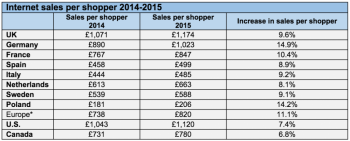
This year, we are predicted to spend nearly £1,200 shopping online, even more than the average American online shopper and around 10% more than in 2014 (Figure 3).

3: UK shoppers spend an average of £1,174 online

Source: econsultancy.com

Delving into the top 50 ecommerce retailers in the UK, 30 of them are from the retail sector, while another 12 are in travel, transportation and leisure.

Some of the top e-tailers are immediately obvious to anyone who has not been living in a proverbial cave: Amazon, Apple iTunes, and eBay.

Online shopping via mobile phones and tablets is now the fastest-growing area of ecommerce. And the top UK mobile retail category for searches is fashion, in the form of clothing, apparel and accessories. 65% of smartphone users search for fashion items using their device, according to Econsultancy (Figure 4).

4: Fashion is the most popular mobile retail search

Source: econsultancy.com

Investing in UK online retail

In the UK, BooHoo (code BOO), Asos (ASC) and Sports Direct (SPD) are all direct beneficiaries of this move to buying sports and fashion clothing online, at the cost of more traditional high street clothing chains such as BHS and TopShop.

Out of BooHoo, Asos and Sports Direct, I am particularly keen on BooHoo and Sports Direct as good long-term online retail plays.

A quick check on the Alexa web ranking website gives a very positive first impression (Figure 5). BooHoo.com is certainly getting more popular relative to other online retailers.

5. BooHoo.com is becoming more popular, relative to other similar websites

Source: Alexa.com

What is more, BooHoo's 10 June trading update highlighted a 35% increase in sales for the 3 months to 31 May, with 3.3 million active customers worldwide (32% more than a year ago).

Very strong growth, backed by lots of cash which can be used to make further investments for future growth too.

All in all, this looks a rather attractive proposition to me at BooHoo's current 28p share price.

Sports Direct harness Click and Collect

Sports Direct's website makes great use of their brick-and-mortar chain of stores to offer a "click and collect" service. With Click and Collect, you first order your sports goods on their website, and then collect the parcel from your chosen local Sports Direct store once it has arrived.

Online sales are now over 14% of Sport Direct's total sales, but are growing at an 11% annual clip and are also helping to improve the company's profitability.

While you pay £4.99 for this delivery option with Sports Direct, you get a £5 voucher back to spend in store when you collect your order. So while in principle you pay nothing for delivery, it cleverly entices you to make another purchase from either the store or the website.

Conclusion: BooHoo and Sports Direct are two great ways to invest in the UK online shopping boom.

Thursday, 28 May 2015

Make money from a strong pound at Marks and Spencer and Majestic Wines

IBTimes Video Link (click below):


This week, pound sterling hit its highest level against other major world currencies for over seven years (figure 1), judging by the Bank of England's Pound sterling index.

Figure 1: Trade-weighted pound back at highest since mid-2008

Source: Bank of England

This latest surge has been driven by the political certainty given by a Conservative general election victory, plus a following wind for the UK economy as:
  • Unemployment continues to fall
  • Retail sales surge higher (+4.7% year-on-year in April 2014)
  • The domestic property market resumes its upwards march.
  • Pound posts big gains against the euro and Aussie dollar


Of the major world currencies, the pound has gained against virtually all of them so far in 2015, save the Swiss Franc (figure 2).

Figure 2: Pound makes big gains against the euro and Australian dollar in 2015

Source: Bank of England

The biggest move has been the near 10% jump against the euro (from €1.29 at the beginning of 2015 to €1.41 currently).

The pound has also posted useful gains against the Australian dollar and Swedish crown too, with only the Swiss franc doing better this year so far.

Why should sterling stop here?

As long as the British economy keeps steaming along and the European Central Bank continues with its programme of bond buying (so-called Quantitative Easing, or QE), we could well see sterling return to the heady heights of €1.50 reached on several occasions between 2004 and 2007 (figure 3).

Figure 3: Pound hit over €1.50 several times 2004-07

Source: Bank of England

After all, the euro remains undermined by the ongoing Greek saga, while the extremist leftist party Podemos has made large gains in the local elections in Spain, underlining the political fragility of the established ruling parties across the eurozone and introducing yet further uncertainty.

Remember, if there is one thing financial markets hate, it is uncertainty – one area where the UK has a clear lead over its continental European cousins with a Conservative majority government now voted in.


How can we make money from a stronger pound?

One sector a canny investor should look at is the retail sector, given the majority of the goods sold on the UK high street tend to be imported. After all, a stronger pound means cheaper prices for imported goods, especially from the eurozone where the exchange rates have moved the most over recent months.

Food and drink is one big category where the UK imports a lot from the likes of Spain, France and Italy. Overall, the UK imports 40% of all the food consumed, much of it from our eurozone neighbours.

This should give a welcome boost to supermarket and upmarket food store chains such as Tesco (TSCO) and Sainsbury's (SBRY). I would focus more on two other retailers where I see potentially greater currency-related benefits.

The first is the venerable Marks and Spencer (MKS), which recently reported strong results. The retailer is continuing its slow transformation into primarily an upmarket food retailer along the lines of John Lewis's successful Waitrose chain.

Its Simply Food store format is enjoying a lot of success, and Marks and Spencer is focusing its new store programme on this format. While we may think fondly of the retailer as the nation's favourite purveyor of underwear, in actual fact food and drink now accounts for 57% of Marks and Spencer's UK sales.

The second retailer who could get a big profit boost from the stronger pound is wine warehouse chain Majestic Wines (MJW).

This £300m company is the UK's largest wine specialist merchant, with 213 stores selling wine by the case to 643,000 active customers.

French, Spanish, Italian and Australian wine imports in particular should all become cheaper in pound terms for Majestic to buy in the coming months and could deliver a useful profit bump.

Majestic should also see faster growth ahead following its recent acquisition of leading online business Naked Wines.

So go shopping for wine bargains thanks to that stronger pound, and why not add Marks and Spencer and Majestic Wines into your shopping basket while you are at it.

Tuesday, 19 May 2015

HSBC and Co-op Bank do battle as sub-1% mortgage wars break out

International Business Times Video Link below:


Could the first sub-1% mortgage rate be around the corner? Actually, it is already here. While the Co-op Bank recently launched a 1.09% two-year fixed-rate mortgage (which will move back to the standard variable rate (SVR) at the end of the term), HSBC has beaten this with an initial rate of 0.99% on its two-year discount special mortgage.

It is hardly surprising then that existing homeowners are thinking about remortgaging to lower their monthly mortgage payments. Surprisingly enough, the SVR on mortgages has actually risen since 2010 and now stands at 4.5%.

Figure 1. Two and five-year fixed mortgage rates still falling 

Source: Bank of England

The average two-year fixed mortgage rate has fallen to under 2%, while the average five-year fixed rate is under 3% (Figure 1). And if you shop around, you can now find sub-2% five-year fixed rates too.

Nearly one in six homeowners are thinking about remortgaging over the next six months, according to a recent Nottingham Building Society survey.

They are hoping to save on average £99 per month, or nearly £1,200 per year. This is all thanks to the ongoing mortgage price war, driving rates ever lower. Let's face it, with the Bank of England base rate at a historic 0.5% low, interest rates are likely to only go one way in the long-term – up.

So remortgaging with a multi-year fixed rate will at least insulate the homeowner against the risk of higher rates for the foreseeable future.

Average mortgage rate on outstanding mortgages

But how much is the average mortgage borrower paying at the moment? The Bank of England says "nearly 3.2%" (Figure 2).

Yes, this average rate has come down over the past five years, but it is still a long way from the current best two and five-year fixed and discount rates on offer today.

Figure 2. Average mortgage rate on outstanding mortgages still over 3%

Source: Bank of England

Let's say you are interested in remortgaging your house or flat. Where would you start and what should you watch out for?

Firstly, you can go the well-trodden route of checking out the online mortgage best buy tables at MoneySuperMarket.com, MoneySavingExpert.com or MoneyFacts.

Before going any further, it is probably a good idea to sit down with your existing mortgage provider to see what they can offer you.

Then if you're not satisfied, try the banks and building societies at the top of these tables. Or you could go to a specialist mortgage broker such as John Charcol or London & Country Mortgages.

But beware, some of these lowest interest rates come with catches: you may be hit with a high "arrangement fee" that can go as high as £1,499, or there may be penalties for early repayment. So be careful to examine the details.

Investing in the mortgage market: challenger banks, specialist lenders

There are some interesting ways to invest in a post-election pick-up in mortgage demand. Instead of looking at the Big Four UK banks, I would look to the new "challenger" banks that have recently been established, or look to specialist mortgage lenders.

Listed challenger banks that are making a splash on the savings and loans markets include Virgin Money (code VM.), Secure Trust Bank (STB), OneSavings Bank (OSB) or Aldermore Group (ALD).

Virgin, OneSavings and Aldermore have all recently listed on the London Stock Exchange and are growing their savings and mortgage businesses quickly as they take business away from the Big Four.

Otherwise, for a really focused mortgage growth play, you could look at the Paragon Group of Companies (code PAG). Paragon specialises in residential mortgages (such as buy-to-let), personal and car loans.

They are forecast to grow profits by more than 10% per year for the next two years and trade on a very reasonable valuation.

Bottom line: if you haven't remortgaged already recently, check out the current best remortgage buys and see if you can save on your monthly payments.

Wednesday, 24 December 2014

Secret Santa's festive stock tips including SuperGroup, Close Brothers and easyJet

Festive Greetings!

Here is my article and accompanying video (3mins 20) focusing on 6 top stock tips for 2015!


With annual New ISA allowances now raised by the government to £15,000 per tax year (to 6 April), and cash savings rates no better than 1.5% on the high street, investing in stocks seems an obvious destination for any long-term ISA-bound savings.

With the potential for the traditional year-end Santa Claus rally close at hand after what has been a turbulent last couple of weeks, which stocks should you consider for your ISA?


Focus on mid-cap gems

Figure 1: Long-Term, FTSE Mid 250 Index Beats FTSE 100 Hands Down. 

Source: Bloomberg

Over the long-term in the UK stock market, mid-caps - the FTSE Mid 250 index - (fig.1) have far outperformed the largest companies such as Vodafone, Royal Dutch Shell and HSBC (FTSE 100 index).

So I have focused on mid-cap gems of companies drawn from different industries, all with appealing value, attractive dividend yields and high profitability; all factors that have been proven to lead to outperformance over the long-term (data kindly supplied by Stockopedia.com).


Figure 2. Six Mid-Cap Gems

Source: Bloomberg

Amlin
(AML, 461p, Insurance)

Lloyd's insurer Amlin (code: AML)  has a very strong record of profitability over the last 10 years, consistently holding or raising its dividend each year. 


Figure 3. Amlin (AML)

Source: Bloomberg

What makes Amlin even more interesting is its dividend yield exceeding 6%, plus the fact that one of its Lloyds counterparts, Catlin has just been boosted by a takeover bid from XL Group.

With Lloyd insurers the subject of merger and acquisition activity, Amlin may also become a target in time.


Berkeley (BKG, 2501p): Building & Construction

Berkeley Group (fig. 4) is a residential house builder focusing on London and the south east, benefiting from recent strong house price inflation in and around the metropolis over the last year or so.

Figure 4. Berkeley Group (BKG, 2501p): Building & Construction. 

Source: Bloomberg


The traditional spring time UK house price pick-up should lift Berkeley next year, not to mention the benefit to housing demand from effective lowering of the stamp duty burden on house sales under £937,000. This supports a very high 7.5% dividend yield, backed by £150m of net cash on its balance sheet.


Close Brothers (CBG, 1464p): Banks

Close Brothers (fig. 5) is a UK-based merchant bank offering a range of services to both business and private clients, as well as broking services and asset management.


Figure 5. Close Brothers (CBG, 1464p): Banks. 

Source: Bloomberg


The current growth in new stock market listings is a very positive trend for the company, while the company's book value has grown steadily over the last six years, the mark of a strong banking business model.

Close Brothers should benefit from strong economic growth, allowing them to grow their business loan book. 

Easyjet

(EZJ, 1604p): Airlines

Easyjet (fig. 6) has been a prime beneficiary of the boom in low-cost airline traffic throughout Europe over the past few years.


Figure 6. Easyjet (EZJ, 1604p): Airlines. 

Source: Bloomberg

The recent collapse in oil prices represents a future boost to profitability, as fuel accounts for a large slice of any airline's costs.

Easyjet has carried increasing numbers of passengers at higher passenger yields, resulting in impressive growth in earnings since 2012, which should continue out to 2016 as it focuses increasingly on capturing more European business travellers. 


Soco(SIA, 272p): Oil & Gas. 

Soco International (fig. 7) is an oil exploration and production company with widespread interests in countries including Vietnam and the Republic of Congo.


Figure 7. Soco International (SIA, 272p): Oil & Gas. 

Source: Bloomberg

It is rare among its oil and gas peers in boasting very steady oil production volumes, a superstrong balance sheet with $284m of net cash and the ability to easily support a robust 5.3% dividend yield from its surprisingly stable earnings stream.

A crude oil price recovery would be a key catalyst for Soco, with Brent back down at $61/barrel versus a June high of $115/barrel.

SuperGroup

(SGP, 815p): Retail.

SuperGroup (fig. 8), the retailer of the Superdry fashion brand, has seen its share price fall from a high of over £17 to less than half of that today, as like-for-like sales growth has gone into reverse (-4% as of the latest interim results).


Figure 8. SuperGroup (SGP, 815p): Retail. 

Source: Bloomberg

In spite of that, SuperGroup should achieve revenue growth of 10% of more over the next two years, with the potential to see even higher profitability as it raises gross margins.

And yet, the company's shares are only valued at 12 times next year's profits, a bargain given the expected revenue growth rate.

These six mid-cap gems offer a rare combination of attractive value, high dividend income and are all very profitable, a potent combination offering substantial upside for 2015.

Merry Christmas and a Happy new Year to you!

Edmund Shing

Tuesday, 16 December 2014

Argos meets online challenge this Christmas with 'click and collect'


IBTimes UK: Argos-meets-online-challenge-this-christmas-click-collect

IBTimes UK Video Link: Argos Meets Online Retail Challenge This Xmas


Christmas present spending has hit an even greater excess this year, an estimated £350 per person and £604 per household in total, by far the largest of any European country (Figure 1).

Black Friday, yet another US consumer import of dubious merit to these shores, has fuelled a high street spending frenzy akin to that of Amazonian piranhas swarming to feed on a hapless victim.

1: British Spend Big At Christmas


Source: ING


While this might sound like the best of times for the retail sector, in reality this is far from the truth.

One only has to look at the ongoing woes of supermarket giant Tesco (LSE code TSCO), now 50% down for the year after four successive profit warnings (Figure 2).

2. The Fall and Fall of Tesco


Source: Bloomberg

Surviving the internet's deflationary effect


But why is that? As always, UK shoppers are demanding ever-better prices on food and non-food goods alike – and we have become savvy as to the price-cutting powers of online price comparison sites like PriceRunner and Kelkoo, allowing us to sniff out the cheapest prices for all manner of goods, electrical or otherwise.

Equally well, access to online shopping sites while at work in front of our computer screens is very tempting for time-poor employees, and a boon for online retailers such as Amazon, eBay and Boohoo.

This shift in shopping patterns has evidently boosted online shopping to the detriment of traditional high street footfall, with online shopping posting 12% growth and hitting over £70bn this year, according to eMarketer (Figure 3).
 
3. Online Ecommerce Sales Over £70bn in 2014


Source: eMarketer.com

Of course, this has not been bad news for all retailers – some traditional high street chains have in fact evolved quickly to meet the online challenge head-on.


One such successful shift in business model towards the "Click and Collect" online shopping paradigm has been Argos, whose listed mother company is Home Retail (code: HOME), with a total of 44% of sales at Argos are now ordered online (Figure 4).

4. Argos Reaps the Benefits of Click and Collect Shopping


Source: Home Retail Group

Fashion retailers bounce back on colder weather?


A second retail subsector that could see better times ahead are clothing chains, who suffered up to November from unseasonal warm weather, slowing sales of their higher-ticket winter items such as coats and boots.

With the current cold snap and the threat of sub-zero temperatures and snow to come, warm weather clothes sales should pick up sharply, with better like-for-like sales expected in January as a result.

This could fuel a bounce in the share prices of high street chains like Next (code: NXT), Marks & Spencer (MKS) and Associated British Foods (ABF; the owners of Primark) and also in smaller, fashion-oriented retailers such as French Connection (FCCN).

Bargains aplenty even before January sales


At this time of year, with Christmas fast approaching and retailers worrying more and more about shifting their inventory sitting on shop shelves, we can play a game of retail chicken.

We the consumers need to buy Christmas presents before Christmas, while the retailers are increasingly worried that they will be stuck with lots of unsold goods post December 25. Who blinks first?

Generally, shops tend to lose this game and discount goods to reduce inventories, increasingly offering discounts even before Christmas to reduce their risk of having to offer even larger discounts in the January sales.

Which of course is good news for those of us who wait until the last minute to complete our present buying.

This year looks likely to be a good one for last-minute bargain hunters, particularly in electronics and clothing.

For cheaper online purchases, I would recommend looking at discount voucher websites such as Vouchercodes.co.uk and Moneysavingexpert.com.

Alternatively, consider snapping up good value shares in retailers such as Next and Home Retail, in advance of potentially upbeat January trading statements.


Tuesday, 9 December 2014

Royal Dutch Shell and BP tie-up would ease the pain for oil and gas investors


Since July, the collapse in world oil prices has been the talk of global financial markets. Brent crude oil, the global benchmark, has fallen from $115 per barrel to under $69 today, a price not seen since 2009 (Figure 1).

1: Brent Crude Oil Back to Prices Not Seen In the Last 5 Years 

Source: Investing.com

This has been painful for investors holding oil and gas stocks such as Royal Dutch Shell (RDS) or BP, with Royal Dutch Shell shareholders nursing losses of 10% since June, and BP shareholders an even more painful 15% loss since June.

Merger and acquisition activity hots up in oil

There have been a number of consequences of this sharp oil price fall, one of which has been an increase in merger and acquisition activity in the global oil and gas sector.

For instance in oil services, Halliburton is in the process of taking over US rival Baker Hughes for $35bn. But perhaps the biggest potential takeover in this sector is still ahead of us...

Could Royal Dutch Shell buy BP?

This sounds ridiculous at first flush – after all, BP is a giant company worth over £136bn at its current 425p share price (as of 5 December). However, it is perhaps not such an outlandish notion upon reflection.

2: BP and Shell Share Prices Have Gone in Different Directions Since 2010 


Source: Yahoo Finance

First of all, at today's 425p BP (code: BP.L) languishes some 34% below its 640p share price reached in March 2010, before the Deepwater Horizon disaster in the Gulf of Mexico took place, costing BP $27bn dollars (so far) in clean-up costs and damages.

In sharp contrast, RDS's A shares (code: RDSA.L) have gained 13% from 1910p in March 2010 to 2149p now (Figure 2). 

As a direct result of this widening gap in relative share price performance, BP is now only worth 64% of the total market value of Royal Dutch Shell, down from almost level pegging back at the end of 2009 (Figure 3). 

3. BP's Market Capitalisation Now only 64% of Royal Dutch Shell's 

Source: Yahoo Finance

Are BP's shareholders fed up with Waiting for Godot?

We could well argue that BP's longstanding shareholders are becoming fed up of waiting for the company to regain the 640p level seen pre-disaster back in April 2010.

BP's sale of its share in the Russian TNK-BP joint venture in return for 20% of Russian oil company Rosneft is not proving a great success.

This stake is worth 38% less today than it was back in early July, thanks to a nasty combination of a falling Rosneft share price together with a collapse in the value of the Russian ruble on the back of international sanctions.

There has been increasing press speculation of late regarding a possible Royal Dutch Shell-BP tie-up, with a mooted £5 per share bid for BP equating to 16% more than Friday's closing share price, financed presumably by the issue of new Royal Dutch Shell shares.

The new Anglo-Dutch oil and gas combo would rank second by size in world oil and gas giants, only a fraction behind the US behemoth ExxonMobil (Figure 4).

4. The Largest Global Oil & Gas Companies

Source: Yahoo Finance. Note: RDS BP combination assumes £5 bid price for BP shares

Given that these large oil companies will find life less profitable in the future at these new, lower crude oil price levels, a cost-cutting (and profit-boosting) merger of these UK oil giants makes sense at present, as it would give the combined entity even greater global scale to compete for new projects. 

Worth mentioning too is that BP offers a juicy prospective dividend of over 6% - so you are paid to wait patiently! Even if a bid from RDS does not materialise, you should still benefit from an eventual rebound in oil prices as global demand grows, as crude oil prices have typically rebounded in the past after such sharp price declines!

Edmund

Tuesday, 2 December 2014

Navigating the Scylla and Charybdis of inflation and deflation


Why is deflation always treated as a dirty word?

When the term deflation is mentioned, the so-called "lost" decade in Japan or the American Great Depression of the 1930s is usually evoked, periods where the economy in question contracted over a long period, resulting in mass unemployment and lower wages.

1: UK Inflation Hits its Lowest Level in 6 Years 

Source: Author, Office of National Statistics

But it is not all dark - There can be a "good" side to deflation too! The UK Government's preferred measure of consumer price inflation (Figure 1, green line) has fallen to only 1.3%, its lowest level for 6 years.

For avid Christmas shoppers, the second, blue line in the figure is great news, as it demonstrates that high street prices are on average 1.2% lower than in November 2013!

So as far as presents under the Christmas tree are concerned, our money should go further this year than last.

That is the positive facet of deflation that we can all enjoy – after all, who doesn't like to snap up a bargain in the shops?

Strong growth and falling inflation: A rare combination

What is interesting at the moment is that this period of falling shop prices is coinciding with relatively fast economic growth in the UK.

In the third quarter (July-September), the UK economy (as measured by Gross Domestic Product) grew by an annualised 3% growth rate (Figure 2), among the fastest growth rates since 2007.

2. UK Economy Is Growing At 3% Per Year 

Source: Tradingeconomics.com, Office of National Statistics


Today, this growth and deflation combination is being encouraged by lower commodity prices, most notably petrol and food prices (Figure 3).

As these two categories represent a large percentage of a typical household's regular spending, no wonder that purchasing power is being boosted as a result. 


3. UK Petrol Pump Price Lowest In Four Years 

Source: Petrolprices.com, Office of National Statistics

Much of this growth is coming from the service sector, an area which the UK tends to excel in (think of financial services including banking and insurance, or media services such as advertising, where the UK tends to lead the world).

Where can we invest to profit from this phenomenon?

Option 1: Low-cost airlines

On these rare occasions when inflation falls but economic growth is booming, what are the best areas to invest in?

First of all, let's outline some general principles. When the economy is growing at above its long-term trend (normally 2.5% or more), so-called "cyclical" sectors which are tied to the prevailing economic trend tend to lead the stock market.

These include manufacturers in sectors such as Machinery and Aerospace & Defence, plus service sectors such as Media, Transport and finally selected financial sectors such as Insurance.

Bearing in mind the relatively sharp fall in oil prices since July, at the stock level I would focus within the Transport sector on low-cost airline stocks such as Ryanair (RYA.L) and easyJet (EZJ.L), which get a profit boost from lower fuel costs, plus a benefit to sales from higher passenger numbers as UK consumers flock abroad in search of cheap holidays.

Option 2: The German stock market

An alternative is to invest in a highly cyclical economy such as Germany.

The country's DAX stock market index is dominated by cyclical manufacturing stocks such as Volkswagen, Daimler and BMW in Autos, BASF and Bayer in Chemicals and Siemens in Industrials.

In addition, the DAX index is not held back by under-performing Oil & Gas stocks as is the case for the FTSE 100, as there are no large-cap German oil companies.

4. Strong Performance From The Amundi Germany ETF 

Source: Morningstar.com

An easy way to invest in the German stock market is the Amundi MSCI Germany UCITS ETF (Figure 4), which is listed on the London Stock Exchange (LSE code: CG1) and is priced in pounds (last price: £147.57).