Showing posts with label Economy. Show all posts

Wednesday, 13 May 2015

On Bloomberg TV: Discussing the Economy

BCS Asset Management’s Edmund Shing and Mizuho International’s Riccardo Barbieri discuss Greece’s ongoing talks with its creditors and an IMF payment that the country made. They speak to Bloomberg’s Jonathan Ferro on “On The Move.” (Source: Bloomberg)

Bloomberg TV link:


Wednesday, 18 March 2015

George Osborne election budget: Tax cuts predicted but no giveaway


That man of the people, Chancellor George Osborne, is sure to mimic Mr Robertson in giving us all some jam in the Budget on 18 March. After all, we are merely two months away from a May general election and the Conservative Party is sure to want to play its usual low tax card.

I would also wager that the Blues will attempt to sway the grey vote their way with further presents for pensioners, in the form of the granting of further pension freedoms. After all, it is clear Ukip have had particular success in appealing to the fiftysomething-plus Saga generation, which has traditionally been the core of Tory support over the post-war decades.

Higher personal allowance on the cards

So let's start with the most obvious tax-oriented measures – the raising of the threshold for the paying of income tax in the form of the personal income tax allowance, currently £10,000 per person per tax year. Firstly, this is one measure the Conservatives and Liberal Democrats continue to agree on. Secondly, the strength of the UK economy allows Osborne to relax his fiscal shackles a little and give back to UK households.


I would pitch for an immediate increase in the personal allowance up to perhaps £12,000 per year (saving all taxpayers £200 per year), with a further pledge to continue raising this threshold if the Conservatives are returned to power.

Of course, some of this largesse is likely to be clawed back via indirect taxes such as higher petrol duty, given how oil prices have collapsed over the last six months or so, allowing UK motorists to buy unleaded petrol today 18% cheaper than it was back in July 2014 (Figure 2).


Benefits for savers – via Isas

Secondly, Gorgeous George will want to help savers, given the paltry interest rates now on offer from high street banks and building societies.

The current Individual Savings Account (Isa) limit has already been raised substantially to £15,000 for the current tax year (from £11,520 previously), and is set to rise to £15,240 under existing government commitments. However, it could go further and perhaps round this amount up to a more generous £16,000, allowing savers to shield earned more interest, dividends and capital gains from income and capital gains tax.

Targeting pensioners – via pension bonds

Remember Pension Freedom Day is approaching with the new tax year, on 6 April.This allows those holding private pensions to liberate them once aged 55 or older, effectively offering a far wider set of financial alternatives for current or those fast approaching retirement. However, this is likely to prove very complicated for the man on the Clapham omnibus, given pensions were an impenetrable subject even before the announcement of these welcome changes.

One set of pensioners who are likely to be targeted by the current government are those who have already used their private pensions to buy an annuity (a product that provides a guaranteed level of income for the remainder of one's life). The potential to trade in an existing annuity for a lump sum instead could well be a new measure introduced in this Budget, extending the liberalisation of private pensions.

A second measure benefiting pensioners could be the extension of the popular Pension Bonds offered by the government-run National Savings & Investments. Currently, pensioners are limited to investing a maximum of £10,000 in each of a 1-year 2.8% bond and a 3-year 4% bond. The government could well increase the amount of these bonds on offer to pensioners to allow more to benefit from these market-beating interest rates, or to increase the amount that a pensioner can invest in each bond.

Caveat voter: All budget commitments could be unwound come May

But you would do well to remember any pre-election giveaways from the chancellor can be unwound following the May general election by any eventual winner. So it would pay not to get too excited by and long-term measures announced during the Budget.

Thus far, the one fact that I can safely state is that there is a record level of uncertainty over the result of this upcoming election, with the two main parties polling less than two-thirds of the total UK vote, a post-war low (Figure 3).


Greatest certainty: Another hung parliament

Taking these average poll results and translating them into parliamentary seat swing predictions, no combination of two parties (apart from Conservatives and Labour) looks capable at present of forming a majority coalition government (Figure 4).

Even a putative Labour and SNP coalition would not yield the necessary minimum Parliamentary majority of 326 seats, falling short by eight MPs.


So what can we conclude from all this? Firstly, any tax giveaways will be limited by the coalition nature of the government, with the Liberal Democrats putting the dampers on any excessive Tory tax cuts.

Secondly, tax-free saving and pensioners should get a boost. And thirdly,  the chance of an inconclusive May election is at present running very high, with the risk of even needing a second election soon after the first...

There remain two months for the main parties to sway current voting intentions their way but they had better get on with it. In the meantime, make sure to use up your current ISA allowance of £15,000 by 5 April (perhaps buying exposure to the current UK & global stock market rally), or else it will be too late.

Wednesday, 21 January 2015

Put your money where your mouth is and buy the mighty US dollar in 2015

International Business Times Article + Video Link


What goes up tends to keep on going up. This is a good mantra for those wondering where to focus their investments now that 2015 is upon us.  

One of the most striking trends in financial markets over the past half-year has been the stunning ascent of the US dollar against virtually all other major currencies, including sterling, the euro and Japanese yen. For a UK-based investor, a simple investment in US dollars in mid-July when £1 bought you over $1.70 would have yielded a return of over 13% to date (Figure 1), with £1 only buying just over $1.50 today.

Figure 1: US Dollar Has Gained 13% Against Sterling Since mid-July 

Source: Bloomberg

Why the US dollar should remain top-dog currency in 2015

Of course, you might look at Figure 1 and take fright: why should you buy into a currency that has already done so well?

After all, it is not every day that a major currency pair like GBP/USD (sterling against the US dollar) moves by this much in a few months.

I see several reasons for the US dollar to make further gains against sterling:

1. The forthcoming UK general election in May introduces all manner of political uncertainty into the UK economic equation, making sterling a more unattractive currency to invest in until at least after the elections are held and the composition of the new government known.

The recent rise of the Ukip vote has added a big variable into the traditional calculation of likely voting outcomes: how highly will Ukip poll come May and could it prevent either of the two traditional parties of power gaining an absolute majority?

2. If the Conservative Party is elected, then Prime Minister David Cameron is likely to proceed with an EU membership referendum. If the Labour Party is elected, financial markets could well react negatively to a less business-friendly administration. Both outcomes would introduce yet further economic uncertainty and undermine the attractiveness of the pound.

3. The UK economy continues to slide closer to deflation with an inflation rate of only 1% and falling, dragged down by the eurozone, which has already registered a negative December inflation print of -0.2%. This will prompt the Bank of England to delay yet further any interest rate hike, again making sterling less attractive versus the US dollar, where an interest rate hike is likely to happen sooner.

How much more could the Greenback gain against the pound? Well a cursory glance at the long-term chart of the US dollar against sterling would suggest there is still some way to go to hit the US dollar's highs reached back in 2009 and 2010 (Figure 2).


Figure 2: US Dollar Can Still Go Some Way to Reach 2009, 2010 Highs 

Source: Bloomberg


Two easy ways to invest in US dollar exposure

Buying US dollars: The most obvious way to take advantage of this trend is to buy US dollars with pounds, particularly if you are thinking of going on holiday to the US sometime this year, as those they could become more expensive the longer you leave it.

I recommend ordering currency online via well-established, regulated institutions such as Best foreignexchange.com, which is offering a rate of over $1.50 per pound, or the currency websites of high-street supermarket chains such as Asda and Tesco, both of which are offering over $1.48 per pound with free click-and-collect services.

Buying US shares via an ETF: The second option is to invest in exposure to US stocks via an exchange-traded fund. Both the Nasdaq and S&P 500 indices remain in long-term uptrends despite the market sell-off of the past few days (Figure 3).

Figure 3: Nasdaq, S&P 500 Indices in Uptrend 

Source: Bloomberg


My preferred US stock ETFs, which you can buy in pounds on the London Stock Exchange (via your preferred stock broker), are:


  1. The Powershares EQQQ Nasdaq-100 UCITS ETF (code: EQQQ), which carries heavy weightings to high-growth technology and biotechnology stocks
  2. The iShares S&P 500 Minimum Volatility UCITS ETF (code MVUS), which carries exposure to US large-cap stocks, focusing on those stocks with lower risk.

Both of these ETFs will give you exposure to US stocks in US dollars with your pounds, and so should benefit not only from any continued gains in US stocks but also from further gains of the US dollar against sterling.

Happy dollar investing in 2015!

2 Bloomberg TV Interviews on European Central Bank, Oil Price

Bloomberg TV Interview 1: Market Is Expecting a Lot From Mario Draghi: Shing


Bloomberg TV Interview 2: Falling Oil Is an Underplayed Risk: Shing


Tuesday, 2 December 2014

Navigating the Scylla and Charybdis of inflation and deflation


Why is deflation always treated as a dirty word?

When the term deflation is mentioned, the so-called "lost" decade in Japan or the American Great Depression of the 1930s is usually evoked, periods where the economy in question contracted over a long period, resulting in mass unemployment and lower wages.

1: UK Inflation Hits its Lowest Level in 6 Years 

Source: Author, Office of National Statistics

But it is not all dark - There can be a "good" side to deflation too! The UK Government's preferred measure of consumer price inflation (Figure 1, green line) has fallen to only 1.3%, its lowest level for 6 years.

For avid Christmas shoppers, the second, blue line in the figure is great news, as it demonstrates that high street prices are on average 1.2% lower than in November 2013!

So as far as presents under the Christmas tree are concerned, our money should go further this year than last.

That is the positive facet of deflation that we can all enjoy – after all, who doesn't like to snap up a bargain in the shops?

Strong growth and falling inflation: A rare combination

What is interesting at the moment is that this period of falling shop prices is coinciding with relatively fast economic growth in the UK.

In the third quarter (July-September), the UK economy (as measured by Gross Domestic Product) grew by an annualised 3% growth rate (Figure 2), among the fastest growth rates since 2007.

2. UK Economy Is Growing At 3% Per Year 

Source: Tradingeconomics.com, Office of National Statistics


Today, this growth and deflation combination is being encouraged by lower commodity prices, most notably petrol and food prices (Figure 3).

As these two categories represent a large percentage of a typical household's regular spending, no wonder that purchasing power is being boosted as a result. 


3. UK Petrol Pump Price Lowest In Four Years 

Source: Petrolprices.com, Office of National Statistics

Much of this growth is coming from the service sector, an area which the UK tends to excel in (think of financial services including banking and insurance, or media services such as advertising, where the UK tends to lead the world).

Where can we invest to profit from this phenomenon?

Option 1: Low-cost airlines

On these rare occasions when inflation falls but economic growth is booming, what are the best areas to invest in?

First of all, let's outline some general principles. When the economy is growing at above its long-term trend (normally 2.5% or more), so-called "cyclical" sectors which are tied to the prevailing economic trend tend to lead the stock market.

These include manufacturers in sectors such as Machinery and Aerospace & Defence, plus service sectors such as Media, Transport and finally selected financial sectors such as Insurance.

Bearing in mind the relatively sharp fall in oil prices since July, at the stock level I would focus within the Transport sector on low-cost airline stocks such as Ryanair (RYA.L) and easyJet (EZJ.L), which get a profit boost from lower fuel costs, plus a benefit to sales from higher passenger numbers as UK consumers flock abroad in search of cheap holidays.

Option 2: The German stock market

An alternative is to invest in a highly cyclical economy such as Germany.

The country's DAX stock market index is dominated by cyclical manufacturing stocks such as Volkswagen, Daimler and BMW in Autos, BASF and Bayer in Chemicals and Siemens in Industrials.

In addition, the DAX index is not held back by under-performing Oil & Gas stocks as is the case for the FTSE 100, as there are no large-cap German oil companies.

4. Strong Performance From The Amundi Germany ETF 

Source: Morningstar.com

An easy way to invest in the German stock market is the Amundi MSCI Germany UCITS ETF (Figure 4), which is listed on the London Stock Exchange (LSE code: CG1) and is priced in pounds (last price: £147.57).

Thursday, 6 November 2014

VIdeo Slideshow: Global Strategy Weekly Review

Here I have recorded a 4-minute video slideshow of key trends
in financial markets over the last week: Please click on the video to watch


All the best, Edmund

Wednesday, 29 October 2014

November 2014 Investment Outlook Preparing for a Year-End Rally

Stock Markets Set Up For Continued Rally

The six weeks from the beginning of September through to mid-October inflicted substantial damage on all major stock markets barring China (Figure 1), with developed markets falling 5-11% and the MSCI Emerging Market index losing 11% over the period. 

1. All Stock Markets Fell from Start-Sept. Except China


Source: Bloomberg

Fears over the strength of the global economy have dominated, with sanctions impacting not only the Russian economy but also those in the Eurozone, including that of the export powerhouse that is Germany. As a result, business confidence in Europe has suffered, putting the brakes on business investment and condemning the Eurozone to a no-growth economy (Figure 2). 

2. German Business Confidence Takes a Big Hit


Source: Bloomberg

However, this quick stock market correction has not taken into account a number of more positive economic trends, including the positive impact of lower oil prices on global consumers. 

Oil Price Plunge Boosts Consumption

The Brent crude oil price has fallen $30 per barrel from mid-June peak to around $85 per barrel currently. Of course, this is bad news for oil exporting countries including OPEC members and Russia. But according to The Economist, if this oil price were maintained, then oil consumers would benefit by paying an oil bill some $1 trillion lower.

The positive effects of this are already starting to be seen through rising US consumer confidence, thanks to retail gasoline prices falling 17% since the end of June to $3.14/gallon now. This should feed through to US GDP growth, heading closer to 3% annual growth based on current encouraging trends in the ISM Manufacturing survey.  

Seasonal Effects Now Turn Positive

In addition, after a turbulent month of October, seasonal trends now turn more favourable from November until the end of April. Historically, the VIX volatility index has peaked in mid-October, and then fallen until Spring-time, a pattern that it is starting to repeat now after touching a 3-year peak of 26 this month (Figure 3).

 3. VIX Volatility Index Calming Down


Source: Bloomberg
    

Prefer Growth to Value: Technology, Healthcare

With the US Federal Reserve edging closer to the end of the current round of Quantitative Easing (QE), this is typically a time to favour Growth as an investment style over Value. 
From an economic point of view, the Technology sector is a growth sector that should benefit from two factors: 

  1. The improving growth in business investment, particularly in IT hardware & software; and
  2. Improving consumer confidence in the crucial Christmas buying season boosting demand for consumer electronics.

Healthcare is a second Growth sector that stands to benefit from the continued growth in healthcare demand from emerging market consumers, and also from the increasing penetration of US healthcare insurance coverage as a result of Obamacare.
     

4. Technology & Healthcare Lead


Source: Bloomberg
        

Where to Focus in November

Aside from remaining convinced that both Technology and Healthcare sectors can move higher still, I believe that global bond yields will remain low for the foreseeable future given the continued savings glut, with investors seemingly unwilling to commit to risky assets and preferring the safe havens of government bonds and even cash. 

But, given that the best predictor of future 10-year returns from government bonds is the current bond yield, the 2.3% on offer in 10-year US Treasuries and the 0.9% offered by German Bunds seems very unattractive, with low-volatility dividend growth stocks more attractive in sectors such as Insurance and even Real Estate.

Finally, the US dollar seems set to continue to strengthen against most other currencies,  given that the European Central Bank and Bank of Japan seems set to do whatever they can to weaken their currencies, while the US Fed is putting an end to QE (at least, for now).
    

5. US Dollar Can Still Recover a Long Way


Source: Bloomberg

Friday, 10 October 2014

Today's CNBC TV Worldwide Exchange appearance: Discussing the return of volatility (VIDEO)

Good morning,

This morning I appeared on CNBC TV’s Worldwide Exchange programme, broadcast to Europe, US and Asia.
Here in this short video clip, I discuss some reasons for the return of volatility to financial markets.


Have a look!

Wednesday, 1 October 2014

Bloomberg TV Interview: On The French economy, budget and their problems...

Please click on the Bloomberg video link below to watch this interview today on the subject of the French economy:


Friday, 22 August 2014

Global Strategy Weekly in Charts: Stocks to return to recent highs, then what?

Macro: Better US Outlook, But Europe Worrying

1. Markit Manufacturing PMI Points to Stronger US Recovery

2. US Initial Jobless Claims Back to Cycle Lows
3. Why the Fed Can Stay on Hold Longer: High 12.2% Under-Employment Rate
4. German 10-year Bond Yield < 1% Higlights Deflation Risk: ECB to Help?


Stock Markets: Tech, Financials Hit New High, Europe Rebounds

5. US Technology, Financials Sectors Break Out to New Highs
6. German Stocks Lagged Word By Over 8%; Now Catch-Up Time

Commodities: Has Crude Oil Found A Bottom At Last?


7. Brent Crude Oil Finally Bouncing Off $102/barrel
8. Oil Services, Exploration/Production Start To Recover
9. Nearly the Season for the Energy Sector To Perform!

Risks: Watch For Mid-Term VIX to Return to <13

10. Mid-Term VIX Volatility Index Under 13 Will Flag Renewed Risk to Stocks
11. Warning: US Retail Sentiment Back to Bullish High (Contrarian Signal)

Investment Summary

  1. US Economic Recovery Seems to be Improving
  2. But High Under-Employment Means the Fed Can Wait…
  3. Risk-On Recovery Driving US Tech Financials To New Highs
  4. European Stocks Still Primed To Recover, But Hinges on the ECB
  5. Opportunity to Return to Oil Stocks As Brent Crude Bottoms
  6. Watch for the Mid-Term VIX to Dip Under 13; then risk/return may change
Edmund

Friday, 6 June 2014

Bloomberg TV June 6, 2014: Draghi's actions were aimed squarely at helping the Euro economy

From my Bloomberg TV interview this morning, here are two videos to watch (just click on the links below):


All the best for the weekend,
Edmund

Wednesday, 9 April 2014

Snap up a DIY bargain in Home Retail

The UK home improvements sector has done very well of late, boosted of course by a combination of a recovering domestic economy, and in particular the feel-good “wealth effect”  which has enveloped home owners as property price inflation has roared back.

Unsurprisingly, retail sales volumes in furniture and lighting have been buoyant, no doubt also aided by purchases following the recent widespread flooding along the Thames Valley – terrible for home owners there and for their insurance companies, but home improvement and furniture retailers have benefited from resultant replacement needs (see UK: Winter storms impact the Home Improvement market). According to Figure 1, furniture & lighting retail sales are showing a 6+% annual growth rate, with a sharp acceleration since the middle of last year.


1. UK FURNITURE & LIGHTING RETAIL SALES TRENDING HIGHER


UK housing the biggest macro driver of DIY

The two biggest quoted UK DIY retailers are Kingfisher (code KGF.L: B&Q in the UK, Castorama in France) and Home Retail (HOME.L: Homebase and Argos in the UK).  The share prices of both of these companies have been somewhat correlated to the UK housing market, with Kingfisher (the green line) in particular following the Royal Institute of Chartered Surveyors UK house price balance index (the black line) very closely over the last few years (Figure 2).


2. KINGFISHER & HOME RETAIL ARE VERY EXPOSED TO HOUSING


Note that Home Retail (the red line) did not rebound in line with the bounce in house prices that started in late 2011, but rather only bottomed out in share price terms in mid-2012, due to company-specific issues in Argos, as it battled a slump in sales of consumer electronics (TVs, audio equipment) with the consumer switching to buying these items online.


To read the rest of the article and see why I find Home Retail attractive,
please click on the web link below: 
  
  
Even if you are not so adept at putting together Ikea flat-pack furtniture, this may still be a great way to get a benefit out of the burgeoning DIY trend! 
  
Edmund 


Tuesday, 11 February 2014

Buy Europe! The ECB will have to give the Euro economy a boost

Why you should buy Europe now, before the ECB acts

Yes, I know that you may be hesitant to buy Continental European stock market exposure, given the travails of the Euro zone since 2008. And you would be right to object that the Euro zone sovereign crisis has by no means been definitively solved, with debt loads of countries such as Portugal, Spain and Italy still pretty enormous.

This is all true and I wouldn’t dream of denying any of these facts. But hey, if you are to look at sovereign debt mountains, then you wouldn’t invest a single penny in the US, Japan or the dear old UK! The final exit from the sovereign debt mountains amassed both before and during the last financial crisis will take a very long time for the respective governments to unwind, as noted by the economists Rogoff and Reinhardt in their seminal tome “This Time is Different” (although there have been some subsequent issues raised concerning their calculations).

What I would argue is that there are a number of green shoots poking through for the Euro zone economy, which should be a harbinger of better days ahead. Added to this, I am a firm believer that the European Central Bank (the ECB for short) will need to stimulate the Euro zone further in the months ahead, which should be unabashed good news for the European stock market. And you have a chance today to buy into relatively cheap European stocks before the ECB unleashes one of their economy-boosting “big bazookas”.


Euro Confidence Is On the Up

Whether you look at leading economic indicators or  economic sentiment indices like the Sentix economic confidence index highlighted below (Figure 1),  the improving macro trend is clear...

Please click on the MindfulMoney website link below to read the entire article, see the charts and also the ETF and investment trust suggestions at the end:

Buy-europe-the-ecb-will-have-to-give-the-euro-economy-a-boost

All the best,
Edmund

Thursday, 6 February 2014

CNBC TV Guest Host! Why I still prefer Insurance to Banks...

Yes, I was once again Guest Host on CNBC Europe's Squawkbox show from 7 to 9am. Thanks to the London Tube strike, I had to get up at 5am to get a car to the studio at 5:30am! 

We discussed a whole slew of company results, including some of my favourite stocks such as Alcatel-Lucent (restructuring and seeing the benefits in better gross profit margins) and AstraZeneca (which every analyst has loved to hate because of its upcoming drug patent expiries like the statin Crestor). 

I was asked what I thought about European Banks in the wake of the announcement of Credit Suisse's results - I maintained that I still prefer Insurance companies to Banks. To find out why, please click on the CNBC TV web link below to watch the video:


While today's Bank of England interest rate announcement should be uneventful, this afternoon's European Central Bank (ECB) announcement could be more interesting, as there is a good argument for the ECB to add further stimulus to help economic growth in the Eurozone. So far, while German manufacturing is picking up nicely, France is lagging badly behind (not helped by President Hollande's antics). 

The Eurozone still needs all the help it can get, so here's hoping that President Draghi does something!

Edmund


Tuesday, 4 February 2014

UK Building is All Systems Go! Stocks to play the theme

Highest UK Construction Confidence in 10 years

If ever anyone needed confirmation that the UK building industry is enjoying the best of times, you only need to look at the record level of UK construction confidence registered this morning in the Markit UK Construction PMI survey - a reading of over 65, confounding analysts' expectations for a fall in confidence. 

Unsurprisingly, residential construction is leading the way, given the buoyant state of house prices nationwide, but most of all in London. You only have to look around London to see the amount of regeneration that is going on, even after the 2012 Olympic Games, for instance in the North and the East End of London.

To see charts and UK stock suggestions to play this strong construction momentum, please click on the Mindful Money website link below:


This is one of my personal favourite investment themes of the moment in the UK, as I feel there is quite a bit further to run in the UK's economic renaissance, with the property market crying out for new builds to alleviate the current shortage of housing supply in London and the South East. 

Edmund  

Thursday, 30 January 2014

Video: What Does the Recent Market Volatility Mean?

Does the recent bout of financial market volatility mean that the bull market in stocks is over? Find out with this video!


Happy viewing, 
Edmund

Twitter:                      @TheIdleInvestor


Global Markets: Are we at a Turning Point?

What to think about the Recent Bout of Emerging Markets-Led Volatility

Wow! This has certainly been an exciting few days for global financial markets, led by sharp weakness in various Emerging Markets (stocks, bonds, currencies). Figure 1 below highlights how the Russian Ruble and Turkish Lira currencies have both suffered extensive weakness against the US dollar over the last month or so, this weakness accelerating over the last few days.


1. Russian Ruble, Turkish Lira Weaken sharply vs. US Dollar

UK-based investors in Emerging Market stocks have been hit over January by the double whammy of falling stock prices and weakening currencies, as foreign investors flee Emerging Markets exposure for "safer" developed markets. As examples, the Templeton Emerging Markets (TEM) and JPMorgan Russian (JRS) investment trusts have suffered drops in excess of 10% since the beginning of November 2013 (Figure 2):

2. Emerging Markets Investment Trusts Take a Battering


EM Tough Also as Export Markets

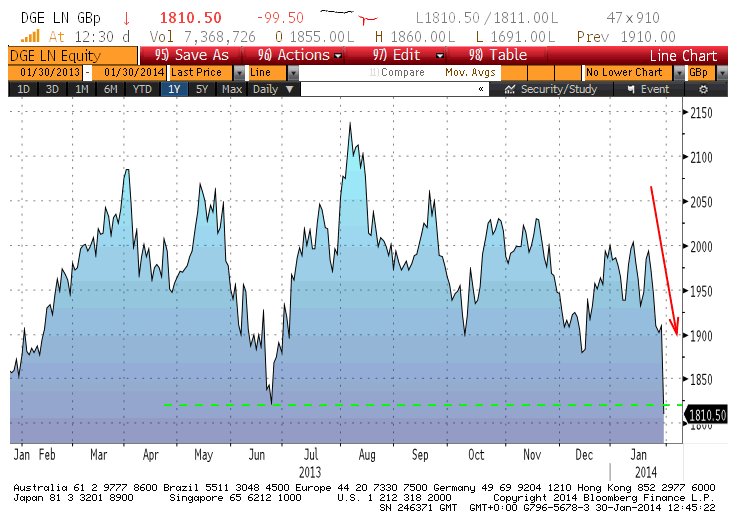
Now, Emerging Markets have not only been tough for foreign investors, but also in business terms for a number of UK-listed companies too: today, the drinks giant Diageo (DGE) announced results, and included the comment that a number of emerging markets had been difficult for them (including Nigeria and Eastern Europe), particularly in their beer division. Rather predictably, their share price has taken a tumble today, down around 5% on this disappointment (Figure 3). 

3. Diageo Also Catches an Emerging Markets Cold

So, should we as investors call time on the bull market in stocks that has been such an enjoyable rise up since November 2012? Or are we at risk of "throwing the baby out with the bathwater", overreacting to a number of problems in Emerging Markets that will not necessarily spell the end of the bull run in Developed Market stocks? 

Putting This in a Longer-Term Context

Let's take a deep breath in, and consider where we find ourselves today in this bull market trend. 

Exhibit A: The Value Line Arithmetic index (VALUA). This index represents the stock price evolution of the average US stock, without reference to size of company. So in this index, a mega-cap like ExxonMobil has exactly the same weight as a US small-cap with a market cap a fraction of Exxon's. And what do we conclude from Figure 4? That the bull market for the average US stock is still intact, in spite of the recent mini-pullback on the back of further Federal Reserve tapering of bond purchases (from $85bn monthly to $75bn monthly in December, and now from $75bn to $65bn monthly). 

4. No Breakdown in the Average US Stock's Bull Run

Exhibit B: The FTSE UK SmallCap index (ex investment trusts: SMXX).UK smallcap stocks  continue to outstrip their mega-cap UK brethren by some margin, and also maintain the bullish uptrend that has been in place since late 2012 (Figure 5): 

5. UK SmallCaps Still Close to Multi-year Highs

Exhibit C: The US VIX Volatility index (VIX). The so-called "Fear Index" has spiked higher in recent days as a result of this emerging markets turmoil, but has still not reached the peaks touched in 2013, never mind the scale of the volatility spikes in 2012 or 2011 during the Eurozone peripheral countries crisis (Figure 6).  

6. The VIX Volatility Index Is NOT at Worrying Levels, At Least Not Yet...

Even excluding the 2008 global financial crisis, the VIX index has averaged a reading of over 19 between 2000 and today. So the current reading of 17.4, while elevated with regards to the mid-January level of 12.5, is still well below the long-term (ex-crisis) average for this stock market volatility measure.  
  
I could go on citing other indicators that do not exhibit any real signs that the uptrend in risk assets is over yet, but I think you all now get the general picture. So far, the clouds on the financial markets horizon do not look pregnant with heavy rain, but rather our investment enthusiasm is being dampened by what seems more like a light drizzle. 

How Will We Know If Matters Turn More Serious? 

Of course, the situation can always change for the worse, and we should always remain alert to such a possibility. I would never deny that there are a number of structural concerns that affect various large emerging economies such as Brazil, Russia and Turkey. However one interesting snapshot that we should watch for clues as to whether this current market pull-back develops into something potentially more concerning is the relative performance of various European stock sectors. 

Normally, during a stock market correction phase, as the market falls so-called "defensive" sectors (with more predictable and less economically-sensitive sales and profits) should outperform more cyclical sectors (with less predictable and more economically-sensitive business models). 

However, thus far this generic financial markets script is not being followed! Figure 7 illustrates that the three worst performers of the 19 industry groups in the STOXX Europe index are all defensive (Personal Goods, Retail and Food & Beverage), the complete reverse of what one should normally expect... And the industry leaders over this 3-month period have actually been cyclical sectors like Travel & Leisure (e.g. airlines), Autos and Construction. 

7. "Defensive" Sectors Have Generally Fared Worst As Emerging Markets Dropped

Perhaps we should not be so surprised at this contrary industry result, given that economic data point to the European economy picking up rather nicely right now, led by none other than good old GB and Northern Ireland!

So what am I looking at right now? 

Without going over the top, I am cautiously adding to my positions in SmallCap stocks where the price trends remain stubbornly positive in the face of a weakening FTSE-100. SmallCaps on my personal radar screen that are breaking new highs include:

Alumasc (ALU), Centaur Media (CAU), Charles Taylor (CTR), Headlam (HEAD), Hogg Robionson (HRG), Quindell Portfolio (QPP), Safestore (SAFE), St. Ives (SIV) and Xchanging (XCH). 

I leave you to do your own research on these smallcap names to decide if they are worthy of your particular investment attention too!

Signing off for now, 

Edmund

Twitter: @TheIdleInvestor