Showing posts with label Stock market. Show all posts

Wednesday, 24 December 2014

Secret Santa's festive stock tips including SuperGroup, Close Brothers and easyJet

Festive Greetings!

Here is my article and accompanying video (3mins 20) focusing on 6 top stock tips for 2015!


With annual New ISA allowances now raised by the government to £15,000 per tax year (to 6 April), and cash savings rates no better than 1.5% on the high street, investing in stocks seems an obvious destination for any long-term ISA-bound savings.

With the potential for the traditional year-end Santa Claus rally close at hand after what has been a turbulent last couple of weeks, which stocks should you consider for your ISA?


Focus on mid-cap gems

Figure 1: Long-Term, FTSE Mid 250 Index Beats FTSE 100 Hands Down. 

Source: Bloomberg

Over the long-term in the UK stock market, mid-caps - the FTSE Mid 250 index - (fig.1) have far outperformed the largest companies such as Vodafone, Royal Dutch Shell and HSBC (FTSE 100 index).

So I have focused on mid-cap gems of companies drawn from different industries, all with appealing value, attractive dividend yields and high profitability; all factors that have been proven to lead to outperformance over the long-term (data kindly supplied by Stockopedia.com).


Figure 2. Six Mid-Cap Gems

Source: Bloomberg

Amlin
(AML, 461p, Insurance)

Lloyd's insurer Amlin (code: AML)  has a very strong record of profitability over the last 10 years, consistently holding or raising its dividend each year. 


Figure 3. Amlin (AML)

Source: Bloomberg

What makes Amlin even more interesting is its dividend yield exceeding 6%, plus the fact that one of its Lloyds counterparts, Catlin has just been boosted by a takeover bid from XL Group.

With Lloyd insurers the subject of merger and acquisition activity, Amlin may also become a target in time.


Berkeley (BKG, 2501p): Building & Construction

Berkeley Group (fig. 4) is a residential house builder focusing on London and the south east, benefiting from recent strong house price inflation in and around the metropolis over the last year or so.

Figure 4. Berkeley Group (BKG, 2501p): Building & Construction. 

Source: Bloomberg


The traditional spring time UK house price pick-up should lift Berkeley next year, not to mention the benefit to housing demand from effective lowering of the stamp duty burden on house sales under £937,000. This supports a very high 7.5% dividend yield, backed by £150m of net cash on its balance sheet.


Close Brothers (CBG, 1464p): Banks

Close Brothers (fig. 5) is a UK-based merchant bank offering a range of services to both business and private clients, as well as broking services and asset management.


Figure 5. Close Brothers (CBG, 1464p): Banks

Source: Bloomberg


The current growth in new stock market listings is a very positive trend for the company, while the company's book value has grown steadily over the last six years, the mark of a strong banking business model.

Close Brothers should benefit from strong economic growth, allowing them to grow their business loan book. 

Easyjet

(EZJ, 1604p): Airlines

Easyjet (fig. 6) has been a prime beneficiary of the boom in low-cost airline traffic throughout Europe over the past few years.


Figure 6. Easyjet (EZJ, 1604p): Airlines. 

Source: Bloomberg

The recent collapse in oil prices represents a future boost to profitability, as fuel accounts for a large slice of any airline's costs.

Easyjet has carried increasing numbers of passengers at higher passenger yields, resulting in impressive growth in earnings since 2012, which should continue out to 2016 as it focuses increasingly on capturing more European business travellers. 


Soco(SIA, 272p): Oil & Gas. 

Soco International (fig. 7) is an oil exploration and production company with widespread interests in countries including Vietnam and the Republic of Congo.


Figure 7. Soco International (SIA, 272p): Oil & Gas. 

Source: Bloomberg

It is rare among its oil and gas peers in boasting very steady oil production volumes, a superstrong balance sheet with $284m of net cash and the ability to easily support a robust 5.3% dividend yield from its surprisingly stable earnings stream.

A crude oil price recovery would be a key catalyst for Soco, with Brent back down at $61/barrel versus a June high of $115/barrel.

SuperGroup

(SGP, 815p): Retail.

SuperGroup (fig. 8), the retailer of the Superdry fashion brand, has seen its share price fall from a high of over £17 to less than half of that today, as like-for-like sales growth has gone into reverse (-4% as of the latest interim results).


Figure 8. SuperGroup (SGP, 815p): Retail. 

Source: Bloomberg

In spite of that, SuperGroup should achieve revenue growth of 10% of more over the next two years, with the potential to see even higher profitability as it raises gross margins.

And yet, the company's shares are only valued at 12 times next year's profits, a bargain given the expected revenue growth rate.

These six mid-cap gems offer a rare combination of attractive value, high dividend income and are all very profitable, a potent combination offering substantial upside for 2015.

Merry Christmas and a Happy new Year to you!

Edmund Shing

Wednesday, 29 October 2014

November 2014 Investment Outlook Preparing for a Year-End Rally

Stock Markets Set Up For Continued Rally

The six weeks from the beginning of September through to mid-October inflicted substantial damage on all major stock markets barring China (Figure 1), with developed markets falling 5-11% and the MSCI Emerging Market index losing 11% over the period. 

1. All Stock Markets Fell from Start-Sept. Except China


Source: Bloomberg

Fears over the strength of the global economy have dominated, with sanctions impacting not only the Russian economy but also those in the Eurozone, including that of the export powerhouse that is Germany. As a result, business confidence in Europe has suffered, putting the brakes on business investment and condemning the Eurozone to a no-growth economy (Figure 2). 

2. German Business Confidence Takes a Big Hit


Source: Bloomberg

However, this quick stock market correction has not taken into account a number of more positive economic trends, including the positive impact of lower oil prices on global consumers. 

Oil Price Plunge Boosts Consumption

The Brent crude oil price has fallen $30 per barrel from mid-June peak to around $85 per barrel currently. Of course, this is bad news for oil exporting countries including OPEC members and Russia. But according to The Economist, if this oil price were maintained, then oil consumers would benefit by paying an oil bill some $1 trillion lower.

The positive effects of this are already starting to be seen through rising US consumer confidence, thanks to retail gasoline prices falling 17% since the end of June to $3.14/gallon now. This should feed through to US GDP growth, heading closer to 3% annual growth based on current encouraging trends in the ISM Manufacturing survey.  

Seasonal Effects Now Turn Positive

In addition, after a turbulent month of October, seasonal trends now turn more favourable from November until the end of April. Historically, the VIX volatility index has peaked in mid-October, and then fallen until Spring-time, a pattern that it is starting to repeat now after touching a 3-year peak of 26 this month (Figure 3).

 3. VIX Volatility Index Calming Down


Source: Bloomberg
    

Prefer Growth to Value: Technology, Healthcare

With the US Federal Reserve edging closer to the end of the current round of Quantitative Easing (QE), this is typically a time to favour Growth as an investment style over Value. 
From an economic point of view, the Technology sector is a growth sector that should benefit from two factors: 

  1. The improving growth in business investment, particularly in IT hardware & software; and
  2. Improving consumer confidence in the crucial Christmas buying season boosting demand for consumer electronics.

Healthcare is a second Growth sector that stands to benefit from the continued growth in healthcare demand from emerging market consumers, and also from the increasing penetration of US healthcare insurance coverage as a result of Obamacare.
     

4. Technology & Healthcare Lead


Source: Bloomberg
        

Where to Focus in November

Aside from remaining convinced that both Technology and Healthcare sectors can move higher still, I believe that global bond yields will remain low for the foreseeable future given the continued savings glut, with investors seemingly unwilling to commit to risky assets and preferring the safe havens of government bonds and even cash. 

But, given that the best predictor of future 10-year returns from government bonds is the current bond yield, the 2.3% on offer in 10-year US Treasuries and the 0.9% offered by German Bunds seems very unattractive, with low-volatility dividend growth stocks more attractive in sectors such as Insurance and even Real Estate.

Finally, the US dollar seems set to continue to strengthen against most other currencies,  given that the European Central Bank and Bank of Japan seems set to do whatever they can to weaken their currencies, while the US Fed is putting an end to QE (at least, for now).
    

5. US Dollar Can Still Recover a Long Way


Source: Bloomberg

Monday, 27 October 2014

Stock Markets May Be Tumbling But Do Not Join the Rush to Make a Hasty Exit

When you work in financial markets, as I do, it is easy to sense the pervading air of panic as stock markets tumble.

Newspapers and websites broadcast sensationalist headlines such as "Countdown to Panic Grips World Markets" and 24-hour news and business TV channels report on a minute-by-minute basis on the immediate loss of paper wealth that the world's investors are suffering – "£46bn lost on the FTSE 100 today".

Luckily, I have a little experience to fall back on, as I have worked in financial markets for the last 20 years now – and have the grey hairs to show for it. What this experience, and a cursory scan of financial market history, tells me is that we now seem to be heading into an overshoot mode.

To read the rest of this article on International Business Times,
please click on this web link:


Edmund

Wednesday, 15 October 2014

VIDEO: Sky Business News Appearance on Global Stock Market Slump

This evenng (Wednesday), I spoke to Ian King about the scale and reasons for the current stock market slump. I also touched on why Initial Public Offerings are being pulled, the latest withdrawn IPO issue being Aldermore (the challenger bank). 

Click on the web link below to view this short video:


Friday, 10 October 2014

Today's CNBC TV Worldwide Exchange appearance: Discussing the return of volatility (VIDEO)

Good morning,

This morning I appeared on CNBC TV’s Worldwide Exchange programme, broadcast to Europe, US and Asia.
Here in this short video clip, I discuss some reasons for the return of volatility to financial markets.


Have a look!

Tuesday, 7 October 2014

‘Tis The Stock Market Season to be Jolly

“Be greedy when others are fearful” 

This quote from one of the most famous investors of our age, Warren Buffett, is one to remember when confronted by a sharp sell-off of the sort that we have witnessed over the last four weeks. 

Challenging a 14-year High

In early September, the FTSE 100 index stood a fraction below the 7000 level, finally a hair’s breadth away from setting a new all-time high (the current all-time high is 6950, set back in late 2000). 

Now here we are in early October, braving the onset of Autumn and cooler temperatures, with stock markets globally also seemingly affected by a similar cooling. The FTSE 100 is now sitting around 6500, roughly 7% lower than a month ago. 

This sharp reversal, triggered by fears over weakening global growth and with the prospect of the US Federal Reserve raising interest rates on the other side of the Pond, has investors scurrying for the relative safety of bonds. According to the Investment Company Institute (www.ici.org), US retail investors have taken a net $2.6 billion out of stock funds and put over $4 billion into bond funds in the month of September. 

Don’t follow the herd and stampede out of shares

Rather than follow this herd, which has typically been late to invest in stock market uptrends and also late to exit stock markets one they have already fallen far, my contrarian instincts tells me to buy into the stock market now, on the basis that one should always be aiming to “buy low and sell high”. 

Several stock market sectors such as Oil & Gas and Food Retail have already suffered heavy falls and are now beginning to rebound. Valuation is relatively attractive too, with the FTSE 100 trading at a 12.5x P/E and paying out a dividend yield only a whisker under 4%. That’s not far off twice the paltry return that you will get for buying the UK government’s 10-year IOUs (I mean government bonds) right now! And even if the International Monetary Fund was relatively downbeat about global economic growth prospects, it was at least positive about the UK…

The Halloween Effect Could Strike (Again)

Let’s not forget about seasonal effects too. The Halloween effect, describing the traditional outperformance of stock markets globally from November through to April, is close to starting. In fact, my own research indicates that a better starting seasonal date for being invested in stocks in developed markets like the UK and US is actually mid-way through October. 

From mid-October through to the end of April, the FTSE 100 has gained an average of nearly 8% per period since 1986 (when the FTSE 100 began). This is the vast bulk of the average 9.5% yearly gain in the FTSE 100 (dividends included), and beats the average May-mid-October period performance of only 1.8% hands down (Chart 1). 

Chart 1: The Halloween Indicator Works Well in UK Stocks

Source: Author, Bloomberg

Follow the Value and Seasonal Trend in the FTSE

The current relative value (comparing the FTSE 100 dividend yield to bond yields) and the positive seasonal effect both argue that we should not overreact to the doom and gloom that surrounds investors at the moment, but rather that we should add exposure to the FTSE 100 in preparation for the strongest stock market half-year. In fact you could argue that this September sell-off could in fact be Christmas come early for the contrarian investor!

Edmund

Thursday, 6 March 2014

My Model ETF/IT Model Portfolio: +2.8% after 3 Weeks...

So Far, So Good…

If we look at the performance of my 6-member portfolio of UK-listed Exchange-Traded Funds (3 in total) and Investment Trusts (another 3) which I launched on Mindful Money on Friday February 10,


I think we can say that it has been satisfactory so far, safely weathering the recent Ukrainian mini-storm (Figure 1).
1. ETF/IT MODEL PORTFOLIO +2.8% SINCE LAUNCH ON FEB. 10
 Source: Author, Bloomberg
All six funds have made ground over the three weeks since launch despite the recent bout of Russian-Ukrainian inspired volatility, which for now at least seems to be calming down as Russia and the West both back away from anything that looks like military action or sanctions.

The benchmark index (comprised of one-third UK FTSE-All Share index and two-thirds MSCI World index in sterling, to match the geographic composition of the portfolio) has risen some 2.3% over the same period – so the portfolio has eked out a small measure of outperformance so far. But in any case, this is largely irrelevant as the portfolio is designed to perform over the medium-term (think years not weeks).


To read the rest of this article, including my thoughts on Russian exposure via an equities investment trust and an emerging market bond ETF,
please click on the Mindful Money web link below:

Edmund's ETF/IT Model Portfolio Up 2.8% in 3 weeks

All the best,

Edmund

Monday, 3 March 2014

Footsie reaches for the 7000 mark. But there are better places for your money!

A lot has been made in recent days of the fact that the iconic FTSE-100 index (that has existed since 1986) is close to breaking its 14-year high, reached during the technology bubble back in early 2000.

Will the Footsie break through to a new multi-decade high? How much further can it go if it does? These questions are all well and good, but are not really the right questions to be asking.


In the Stock Market, Size is not Everything!

Should you even be looking at the benchmark FTSE-100 index at all? The real value creation in the UK stock market has not been in these largest of companies, dominated over time by Banks, Telecoms companies and Oil majors. Instead, investors have been far better served by the mid- and small-cap segments of the UK market, not only over the past 14 years but even further back as well.
Including reinvested dividends over time, the FTSE-100 has given investors a mere 3.7% on average since the end of 1999 (the line in black on the chart – and that’s not counting management fees even in an index fund); compare this to the 6.5% pre-fees from the Small-Cap index (in green) and an impressive 10.2% pre-fees from the Mid-250 index (in red), nearly three times the average return from large-caps!

This was largely achieved through two key biases:

1. A bias towards domestic economic exposure, which is greater in the mid- and small-cap segments of the stock market. In contrast, FTSE-100 companies tend to be global by nature, and indeed often have little to do with the UK per se (look at the Miners, for example).

2. Low weightings in hard-hit sectors, such as Banks, Insurance, Telecoms and Oil Majors. All of which have come a cropper either during the recent Financial Crisis, or before that post the 1999-2000 Tech bubble.

3. Let us not forget either that smaller companies generally also post higher growth rates in sales and profits too…

Despite this superior performance record for mid- and small-caps, you can’t even make the argument that mid- and small-cap companies are now systematically over-valued with respect to their large-cap counterparts: the estimated Price/Earnings ratio for the FTSE 100 is a little lower than for the Mid 250 index at 12.5x versus 14.6x, but it is not as low as for UK Small Caps, which trade at only 11x estimated end-2014 profit.

To see the charts, and look at the ETF and investment trust selections that I think will beat the FTSE-100 going forwards, please click on the Mindful Money web link below:

Until the next time,Edmund

Wednesday, 26 February 2014

View my CNBC WorldWide Exchange TV interview!

Here is the video link to to my CNBC Worldwide Exchange interview from this morning:


Click on it and have a look!

Best,
Edmund

Tuesday, 11 February 2014

Buy Europe! The ECB will have to give the Euro economy a boost

Why you should buy Europe now, before the ECB acts

Yes, I know that you may be hesitant to buy Continental European stock market exposure, given the travails of the Euro zone since 2008. And you would be right to object that the Euro zone sovereign crisis has by no means been definitively solved, with debt loads of countries such as Portugal, Spain and Italy still pretty enormous.

This is all true and I wouldn’t dream of denying any of these facts. But hey, if you are to look at sovereign debt mountains, then you wouldn’t invest a single penny in the US, Japan or the dear old UK! The final exit from the sovereign debt mountains amassed both before and during the last financial crisis will take a very long time for the respective governments to unwind, as noted by the economists Rogoff and Reinhardt in their seminal tome “This Time is Different” (although there have been some subsequent issues raised concerning their calculations).

What I would argue is that there are a number of green shoots poking through for the Euro zone economy, which should be a harbinger of better days ahead. Added to this, I am a firm believer that the European Central Bank (the ECB for short) will need to stimulate the Euro zone further in the months ahead, which should be unabashed good news for the European stock market. And you have a chance today to buy into relatively cheap European stocks before the ECB unleashes one of their economy-boosting “big bazookas”.


Euro Confidence Is On the Up

Whether you look at leading economic indicators or  economic sentiment indices like the Sentix economic confidence index highlighted below (Figure 1),  the improving macro trend is clear...

Please click on the MindfulMoney website link below to read the entire article, see the charts and also the ETF and investment trust suggestions at the end:

Buy-europe-the-ecb-will-have-to-give-the-euro-economy-a-boost

All the best,
Edmund

Saturday, 8 February 2014

The Idle Investor Weekly Newsletter: 8 February 2014

Market Outlook: Are We Already Back to the Races?

As per the usual script, this recent stock market correction was unexpected and sudden on the downside, illustrating once again that while stock markets may go up steadily, they tend to drop out of bed quickly and without much warning, catching the majority of investors by surprise.

And just as everyone starts to panic and sell any exposure they have to Emerging Markets (which have suffered mutual fund huge outflows in the US over the month of January), stock markets in the US and Europe have started to recover, and volatility has started to go back down. The US VIX volatility index (commonly known as the “Fear index”) has already eased back to just over 15, after rising from 12 to a peak of over 21 (Figure 1).


1. The US VIX Volatility Index Is Receding Quickly


Even some of the worst-affected emerging markets such as Russia have even some measure of stability return to their currencies, after suffering a sharp bout of depreciation against the US dollar. 

Is this a buying opportunity, or is it too early?

This is a fair question. I would suggest that the issues that triggered the turmoil in emerging markets are far from being solved.

However the structural issues facing countries such as Turkey and Brazil are far from being as serious as those faced by Asian economies or Russia back in the crises of 1997 and 1998. 

Personally, I would not be buying into emerging markets just yet despite the compelling value they seem to offer, as they can always get cheaper still in the short-term, as has been pointed out by Templeton’s famed emerging markets guru Mark Mobius. On the other hand, developed stock markets such as the UK and Continental Europe do look attractive to me post their recent declines, as do certain US stock market sectors such as Oil Services. 

If you are determined to buy some cheap emerging market exposure as a committed long-term investor, then can I recommend you look at relatively well-developed Asian economies such as South Korea and Taiwan. Both of these countries are home to a number of world-leading industrial and technology companies, including Samsung, LG and Hyundai, to mention but a few. They also do not have economies that are vulnerable to pressures on external debt funding. You can see from the chart below that the South Korean KOSPI index has started to bounce after a slump from the start of December (Figure 2). 

2. The South Korean KOSPI Index Stars to Rebound


So where are the best opportunities right now? I thought I would form my own model portfolio of exchange-traded funds (ETFs) and investment trusts, that I feel are best-placed to gain ground over the next few months. 

NEW! The Idle Investor’s Model ETF & IT Portfolio

The table below details the 6 UK-listed ETFs and investment trusts (3 of each) that I favour at the moment. There are a number of other ETFs and closed-end funds that I am keen on in the US, but have not included here for reasons of simplicity.


Company                           Code Price (Fri)

iShares MSCI UK Small-Cap ETF    CUKS.L    15,027p
Source GLG/Man Europe Plus ETF   MPFE.L      10,999p
iShares Japan GBP-Hedged ETF     IJPH.L        4151p
Invesco Perp. Enhanced Income IT IPE.L          73p
Fidelity Asian Values IT          FAS.L         198p
Herald IT                         HRI.L         715p


A few notes on each fund:

CUKS.L (UK Small-Cap Stocks) – I am very enthusiastic about UK mid- and small-cap exposure, which held up much better than the FTSE 100 in the recent correction, and which should benefit more than their larger compatriots from the strength in the UK economy (as the largest companies tend to be more global in focus). This iShares MSCI UK Small-Cap ETF is a good way to buy exposure to this UK investment style relatively cheaply, without going to all the effort of buying a basket of individual small-cap stocks.

MPFE.L (European Stocks) – This Source ETF is an interesting twist on a European stock fund, as it combines the best stock picks from investment banks in a single fund. Historically, this ETF has outperformed the broad European stock market by around 2% per year, so the model clearly seems to work in adding performance.

IJPH.L (Japanese stock market, hedged) – This iShares Japan ETF is a way to invest in Japan without taking Japanese yen currency risk. After all, one of the reasons that Japanese companies like Toyota are growing their profits is the competitive advantage conferred on these exporters by a weaker currency. However, that is not such good news for an investor based in a currency other than the yen, as then their yen-based assets tend to depreciate. This fund neatly sidesteps the problem by hedging the yen each month back into sterling. 

IPE.L (European Corporate Bonds) – the Invesco Perpetual Enhanced Income Trust is an investment trust that invests in UK & European corporate bonds, and through application of 25% gearing, offers a dividend yield not far off 7% at present. Rare to see such a high yield these days…

FAS.L (Asian Stocks) – The Fidelity Asian Values Trust is an Asia-focused investment trust that is heavily weighted towards South Korea, Hong Kong and China, and which trades at a 12% discount to net asset value following the recent emerging markets rout.

HRI.L (UK Small-Cap Technology & Media) – The Herald Investment Trust is a specialist investor in UK small-cap technology, media and telecoms stocks. Historic performance has been strong, it is invested in both sectors and the size style (smaller companies) that I prefer, and also trades at a 12% discount to net asset value. 

So there you have it, 6 of my current UK-listed fund favourites, all in one portfolio. These can be used by an idle investor to invest in a relatively well-diversified set of assets, without the need to delve into choosing individual stocks, and all achieved at low management charges. 

I will track the performance of this portfolio over the weeks that follow, so we shall see if it is an inspired set of choices or not!

This Week’s Articles, In Case You Missed Them…

I wrote an article on the UK Construction sector in my MindfulMoney Expert Opinion column this week:

1. UK Building Is All Systems Go! If ever anyone needed confirmation that the UK building industry is enjoying the best of times, you only need cast your eyes over the recent UK Construction Confidence survey from the firm Markit, that was released this morning, which hit a new high at nearly 65. Which stocks should benefit from this strength in building? Click on the article to find out…

There have also been a couple of videos you can watch:

2. CNBC TV Guest Host: Why I still prefer Insurance to Banks.... I was asked what I thought about European Banks in the wake of the announcement of Credit Suisse's results - I maintained that I still prefer Insurance companies to Banks. To find out why, please click on the CNBC TV web link below to watch the video…

3. Bloomberg TV Interview: On Emerging Markets, the allure of Technology The topics of this 5-minute interview were the value that can be found today in Emerging markets and European stock markets, following the current correction, and my continuing fondness for the Technology sector.

And if you would like to see and listen to my slideshow presentation with audio commentary on why further monetary stimulus efforts from the European Central Bank are key to the investment case for the European stock markets, click on the video link below:


Have a great week ahead, and please don’t hesitate to recommend this newsletter to anyone who you know may be interested: to subscribe, please just email me at

idleinvestor@idleinvestor.com

The best of luck for the week ahead,
Edmund

Friday, 31 January 2014

The Idle Investor Weekly Newsletter: 31 Jan 2014

Market Outlook:
Just When You Thought All Was Plain Sailing…

After what has turned out to be a rather decent 2013 for those who dared to invest in the stock market, the last couple of weeks in January have stood in stark contrast, a bit of a horror show that has seen the FTSE-100 index (UKX) drop over 300 points. 


But let’s not panic just yet. Yes, a number of emerging markets such as Turkey and Russia have revealed their structural flaws, but at the same time, economic growth is picking up both in the US and in Europe. So the news is certainly not all bad!
For small-cap investors, the picture actually looks rather more cheery. Despite a similar pullback since the middle of this month, the uptrend in the FTSE Small-Cap index (SMX) remains very much intact, with a large number of small-cap stocks that I watch closely breaking out to new price highs.


Remember: normally momentum is persistent. Another way to say this is that in stock markets, what goes up often just continues to go up, particularly after making new highs! So, for those who are interested, here is a non-exhaustive list of those small-caps on my personal radar screen that have broken out to new recent share price highs:


As always, before investing in any of these stocks, please remember that there is no substitute for doing your own research!

Put the correction in context!

Just remember that 2013 was a monster year for stock markets, particularly for the US, and that nothing can go up forever, at least not without taking a breather every now and then. To put things in context, this current correction is nothing like as bad as what we saw in the middle of last year, and yet stocks went on to regain all their losses and a lot more by the end of the year.

And remember, there are not many attractive places left to put your long-term savings. Cash deposits yield even less than ever before, you will be lucky to get a 2%+ rate on deposit accounts these days (I find the Nationwide Building Society one of the best in this respect, once you have exhausted the very limited Regular Saver accounts at the likes of Lloyds, HSBC and First Direct which offer 5% or 6% interest rates on limited amounts). 

Bond yields have come down again, so lending your money to the UK government is not very attractive – you get 1.6% BEFORE tax if you buy a 5-year gilt. You may prefer a bricks-and-mortar investment, with house prices on the rise and even getting quite overheated in London (I should know, I am looking myself!). Unfortunately, thanks to the government’s Help to Buy schemes, London property is literally flying off estate agents’ shelves – I contacted three estate agents in the middle of the week with a view to viewing 8 properties that were for sale, only to be informed that each one had already been sold or gone under offer. House prices are rising much faster than rents, with the result that effective rental yields for buy-to-let investments are falling fast, making them less attractive. 

At the end of the day, I think it is too early to throw in the towel on stocks and shares. In Europe, they continue to provide good value and in general a decent yield, ahead of what one can get from government bonds or cash deposits. This is perhaps less true in the United States, but even there there are still pockets of value, for instance in the large-cap technology stocks like Microsoft and Cisco. 

This Weeks’ Articles, In Case You Missed Them…

I wrote a couple of articles in my MindfulMoney Expert Opinion column this week:

1. RBS reminds me why I prefer Insurers to Banks: the awful results from RBS this week, with massive provisions yet again for a number of mis-selling scandals, highlight why I remain cautious on the Banks sector, and instead prefer to invest in Insurers, particularly in the closed life fund subsector, with names such as Chesnara, Resolution and Phoenix Group on my watch list. 

2. Are Global Markets At a Turning Point? As I have explained above in the Market Outlook, I think it is too early to say that the bull market in stocks is over, and in this article I have included a number of charts to support my optimistic viewpoint.

There have also been a couple of videos you can watch:

3. Investment Ideas for 2014 Which does what it says on the tin…

4. What Does the Recent Market Volatility Mean? This is a slide show with audio commentary, leading you though the key charts and conclusions to draw following this recent emerging markets-led sell-off.

Have a great week ahead, and please don’t hesitate to recommend this newsletter to anyone who you know may be interested: to subscribe, please just email me at edmundshing1@gmail.com

Signing off for now,
Edmund


Thursday, 30 January 2014

Video: What Does the Recent Market Volatility Mean?

Does the recent bout of financial market volatility mean that the bull market in stocks is over? Find out with this video!


Happy viewing, 
Edmund

Twitter:                      @TheIdleInvestor


Global Markets: Are we at a Turning Point?

What to think about the Recent Bout of Emerging Markets-Led Volatility

Wow! This has certainly been an exciting few days for global financial markets, led by sharp weakness in various Emerging Markets (stocks, bonds, currencies). Figure 1 below highlights how the Russian Ruble and Turkish Lira currencies have both suffered extensive weakness against the US dollar over the last month or so, this weakness accelerating over the last few days.


1. Russian Ruble, Turkish Lira Weaken sharply vs. US Dollar

UK-based investors in Emerging Market stocks have been hit over January by the double whammy of falling stock prices and weakening currencies, as foreign investors flee Emerging Markets exposure for "safer" developed markets. As examples, the Templeton Emerging Markets (TEM) and JPMorgan Russian (JRS) investment trusts have suffered drops in excess of 10% since the beginning of November 2013 (Figure 2):

2. Emerging Markets Investment Trusts Take a Battering


EM Tough Also as Export Markets

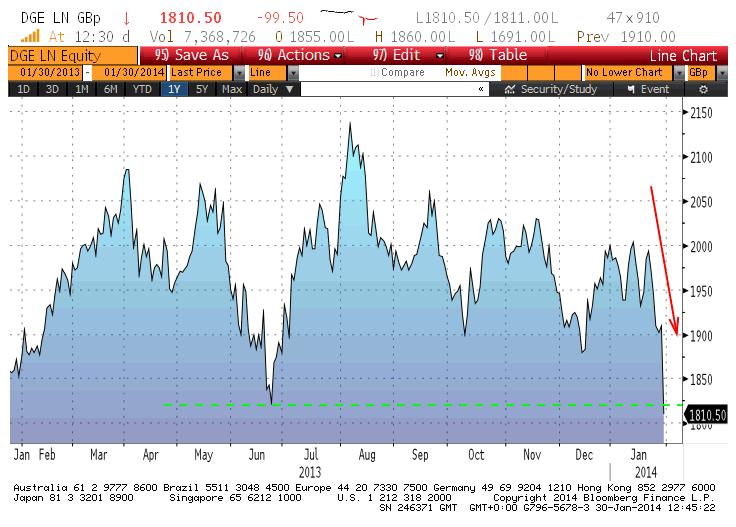
Now, Emerging Markets have not only been tough for foreign investors, but also in business terms for a number of UK-listed companies too: today, the drinks giant Diageo (DGE) announced results, and included the comment that a number of emerging markets had been difficult for them (including Nigeria and Eastern Europe), particularly in their beer division. Rather predictably, their share price has taken a tumble today, down around 5% on this disappointment (Figure 3). 

3. Diageo Also Catches an Emerging Markets Cold

So, should we as investors call time on the bull market in stocks that has been such an enjoyable rise up since November 2012? Or are we at risk of "throwing the baby out with the bathwater", overreacting to a number of problems in Emerging Markets that will not necessarily spell the end of the bull run in Developed Market stocks? 

Putting This in a Longer-Term Context

Let's take a deep breath in, and consider where we find ourselves today in this bull market trend. 

Exhibit A: The Value Line Arithmetic index (VALUA). This index represents the stock price evolution of the average US stock, without reference to size of company. So in this index, a mega-cap like ExxonMobil has exactly the same weight as a US small-cap with a market cap a fraction of Exxon's. And what do we conclude from Figure 4? That the bull market for the average US stock is still intact, in spite of the recent mini-pullback on the back of further Federal Reserve tapering of bond purchases (from $85bn monthly to $75bn monthly in December, and now from $75bn to $65bn monthly). 

4. No Breakdown in the Average US Stock's Bull Run

Exhibit B: The FTSE UK SmallCap index (ex investment trusts: SMXX).UK smallcap stocks  continue to outstrip their mega-cap UK brethren by some margin, and also maintain the bullish uptrend that has been in place since late 2012 (Figure 5): 

5. UK SmallCaps Still Close to Multi-year Highs

Exhibit C: The US VIX Volatility index (VIX). The so-called "Fear Index" has spiked higher in recent days as a result of this emerging markets turmoil, but has still not reached the peaks touched in 2013, never mind the scale of the volatility spikes in 2012 or 2011 during the Eurozone peripheral countries crisis (Figure 6).  

6. The VIX Volatility Index Is NOT at Worrying Levels, At Least Not Yet...

Even excluding the 2008 global financial crisis, the VIX index has averaged a reading of over 19 between 2000 and today. So the current reading of 17.4, while elevated with regards to the mid-January level of 12.5, is still well below the long-term (ex-crisis) average for this stock market volatility measure.  
  
I could go on citing other indicators that do not exhibit any real signs that the uptrend in risk assets is over yet, but I think you all now get the general picture. So far, the clouds on the financial markets horizon do not look pregnant with heavy rain, but rather our investment enthusiasm is being dampened by what seems more like a light drizzle. 

How Will We Know If Matters Turn More Serious? 

Of course, the situation can always change for the worse, and we should always remain alert to such a possibility. I would never deny that there are a number of structural concerns that affect various large emerging economies such as Brazil, Russia and Turkey. However one interesting snapshot that we should watch for clues as to whether this current market pull-back develops into something potentially more concerning is the relative performance of various European stock sectors. 

Normally, during a stock market correction phase, as the market falls so-called "defensive" sectors (with more predictable and less economically-sensitive sales and profits) should outperform more cyclical sectors (with less predictable and more economically-sensitive business models). 

However, thus far this generic financial markets script is not being followed! Figure 7 illustrates that the three worst performers of the 19 industry groups in the STOXX Europe index are all defensive (Personal Goods, Retail and Food & Beverage), the complete reverse of what one should normally expect... And the industry leaders over this 3-month period have actually been cyclical sectors like Travel & Leisure (e.g. airlines), Autos and Construction. 

7. "Defensive" Sectors Have Generally Fared Worst As Emerging Markets Dropped

Perhaps we should not be so surprised at this contrary industry result, given that economic data point to the European economy picking up rather nicely right now, led by none other than good old GB and Northern Ireland!

So what am I looking at right now? 

Without going over the top, I am cautiously adding to my positions in SmallCap stocks where the price trends remain stubbornly positive in the face of a weakening FTSE-100. SmallCaps on my personal radar screen that are breaking new highs include:

Alumasc (ALU), Centaur Media (CAU), Charles Taylor (CTR), Headlam (HEAD), Hogg Robionson (HRG), Quindell Portfolio (QPP), Safestore (SAFE), St. Ives (SIV) and Xchanging (XCH). 

I leave you to do your own research on these smallcap names to decide if they are worthy of your particular investment attention too!

Signing off for now, 

Edmund

Twitter: @TheIdleInvestor